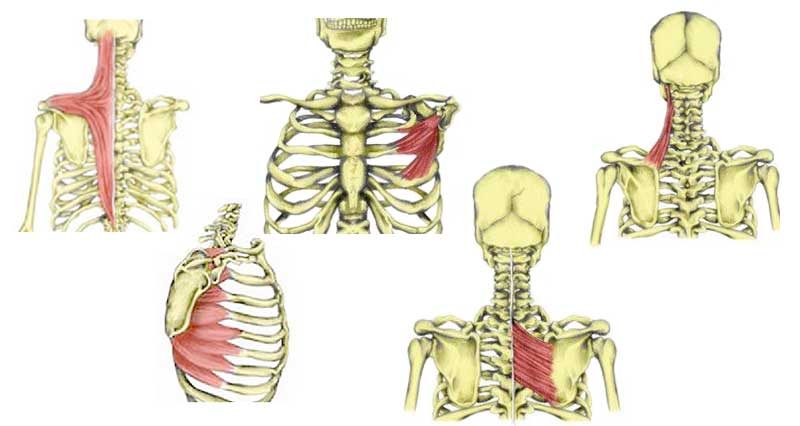
The Shoulder girdle muscles move the clavicle (collar bone) and the scapula (shoulder blade). These generally move together as a unit. The muscles of the shoulder girdle are serratus anterior, pectoralis minor, levator scapulae, rhomboids, and trapezius.
Movements of the shoulder girdle
The movements (actions) of the shoulder girdle consist of:
- Elevation – moving upwards or shrugging your shoulders.
- Depression – moving shoulders downwards.
- Protraction – pushing shoulders forwards, rounding or ‘hunched’ shoulders.
- Retraction – moving shoulders backwards.
Shoulder girdle muscles
Learn the muscles then test yourself with our shoulder girdle muscles quiz.
Serratus Anterior
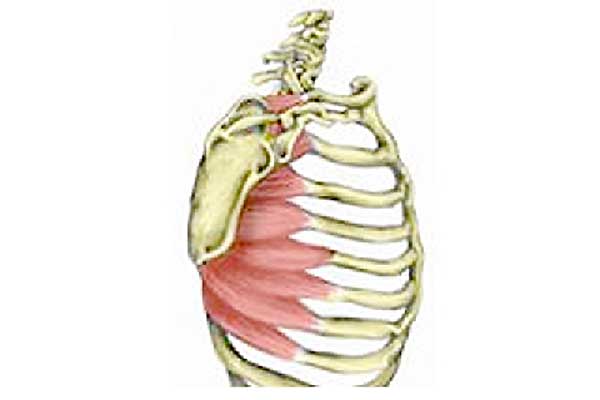
The Serratus Anterior muscle is used in activities which draw the scapula forwards. It is used strongly in push-ups and bench presses. The winged scapula is an indicator of having a weak Serratus Anterior muscle.
- Daily uses include reaching up to open a high window. Simple strengthening exercise example – push-ups or press-ups.
- Origin – Upper nine ribs at the side of the chest and inserts at the costal aspect (side articulating with the ribs) of the medial border of the scapula.
- Actions – Scapula protraction and rotation of the scapula upwards.
- Innervation – long thoracic nerve.
Pectoralis Minor
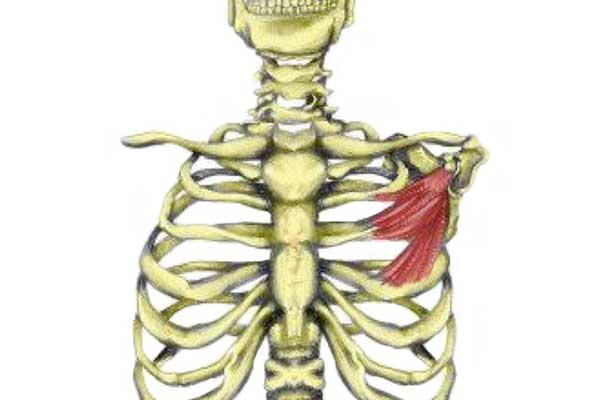
The Pectoralis Minor muscle is the smallest of the two pectoral (chest) muscles. It works together with Serratus anterior which protracts and rotates the scapula upwards. When the two work together, pure protraction (without rotation) is produced.
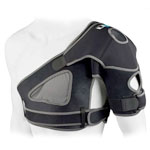
Daily uses include pushing a door open. Example strengthening exercises – Pec fly using a resistance band and Chest Press using a resistance band. Example stretches – chest stretch and chest stretch with a partner.
- Origin – outer surface of ribs 3-5.
- Insertion – coracoid process of the scapula.
- Actions – scapula protraction and rotation of the scapula downwards.
- Innervation – medial pectoral nerve.
Levator Scapulae
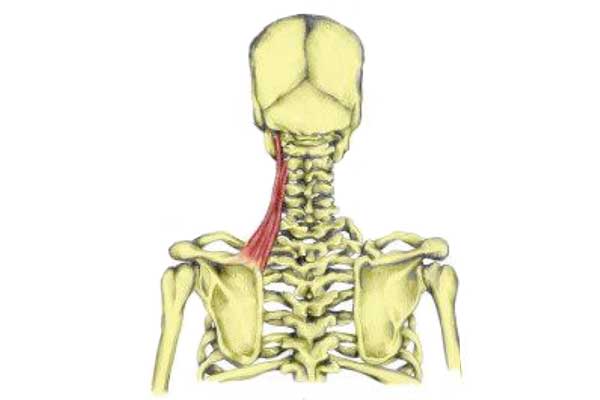
Shrugging the shoulders (scapula elevation) requires the use of levator scapulae and Trapezius. Fixation of the scapula by other muscles, allows the levator scapulae muscles to work together to aid cervical extension, or independently to laterally flex (side bend) the neck towards the side of the working muscle.
Daily uses include shrugging shoulders or carrying a heavy shopping bag. Example strengthening exercises – Shrugs. Example stretches Lateral neck flexion stretch and Forward neck flexion stretch
- Origin – Transverse processes of C1-4
- Insertion – Medial border of the scapula above the level of the scapula spine.
- Actions – Scapula elevation, Lateral flexion of the cervical spine (each side independently), Extension of the cervical spine (each side independently)
- Which nerves supply this muscle? – Cervical nerve, Dorsal scapular nerve
Rhomboids
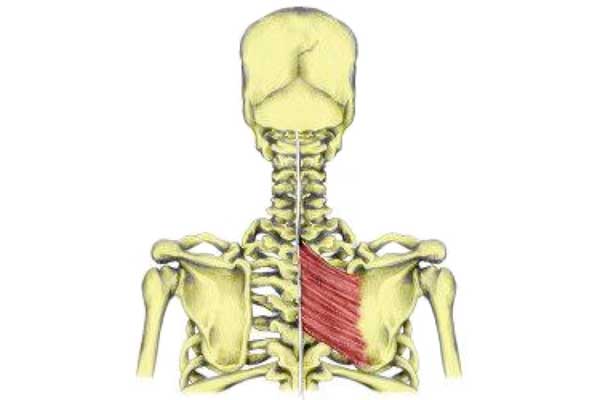
There are two rhomboid muscles – Rhomboid Major and Rhomboid Minor. Rhomboid major is larger and positioned below rhomboid minor. Chins and dips are excellent activities for developing these muscles.
Daily uses include pulling a drawer open. Example Strengthening exercise – reverse fly with a resistance band and seated row with a resistance band. Example stretches – Posterior shoulder stretch.
- Origin-Spinous processes of C7-T5.
- Insertion– Medial border of the scapula, below the level of the spine of the scapula.
- Actions- Scapula retraction (bringing the shoulder blades together), Rotation of the scapula downwards
- Innervation- Dorsal scapular nerve.
Trapezius Muscle
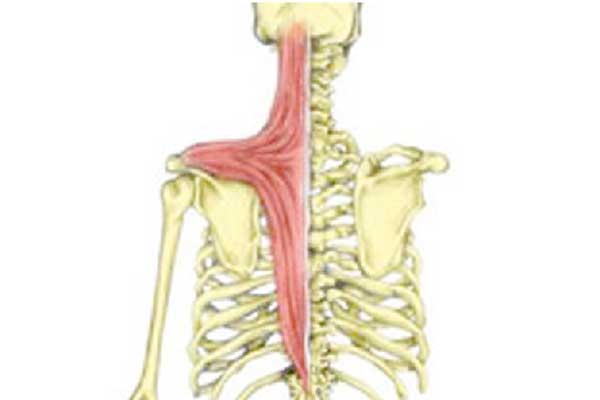
The trapezius muscle (Trapz) is a large muscle consisting of four parts covering the upper back, shoulders, and neck. It is used in shrugging the shoulders and with overhead movements.
- Part 1: Upper fibres of the cervical vertebrae. This is the weakest part of the muscle and only provides minor elevation of the clavicle.
- Part 2: The area commonly known as the upper traps. This is a strong elevator, rotator, and retractor of the scapula.
- Part 3: The mid-portion of the Trapzius. These fibres are mainly responsible for scapula retraction.
- Part 4: The lower fibres of Trapezius. This part of the muscle assists in retraction and rotation.
When all parts of the muscle work together they have the effect of simultaneously elevating and retracting the scapula. The Trapezius is one of the shoulder girdle muscles most commonly used to fix the scapula, to allow the Deltoid to move the Humerus.
- Origin: Occipital protuberance (base of skull), ligaments cervical spine and spinous processes of C7-T12
- Insertion: Posterior outer 1/3 of the clavicle, acromion process and spine of the scapula
- Actions: Scapula elevation, scapula retraction and Upward rotation of the scapula
- Innervation: Cranial nerve
- Daily uses: Shrugging shoulders, overhead movements
- Exercises: Shoulder shrugs with dumbells, reverse fly using a resistance band.
- Stretches: Lateral Neck Flexion, forward Neck Flexion, and Neck rotation
Test yourself with our shoulder girdle muscles quiz.