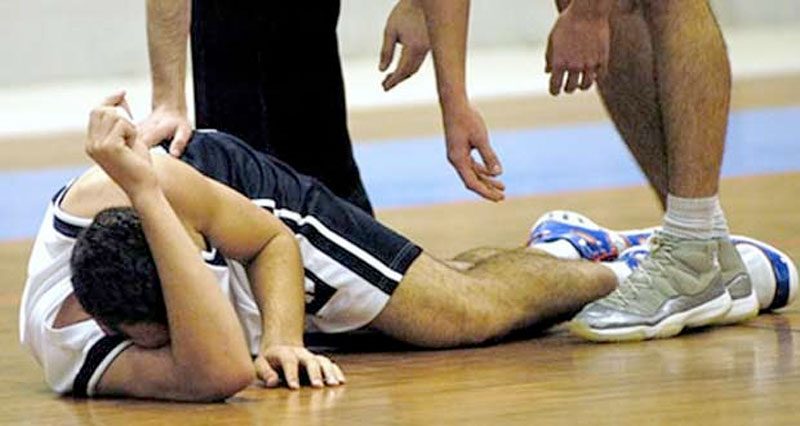
Basketball injuries are some of the most varied sports injuries! They commonly range from the fingertip to the toe and everything in between! This is because of the use of the hands, wrists, fingers, and arms for throwing, as well as the running, jumping, bounding and changing direction, partial contact, and a lack of protective clothing!
Common basketball injuries
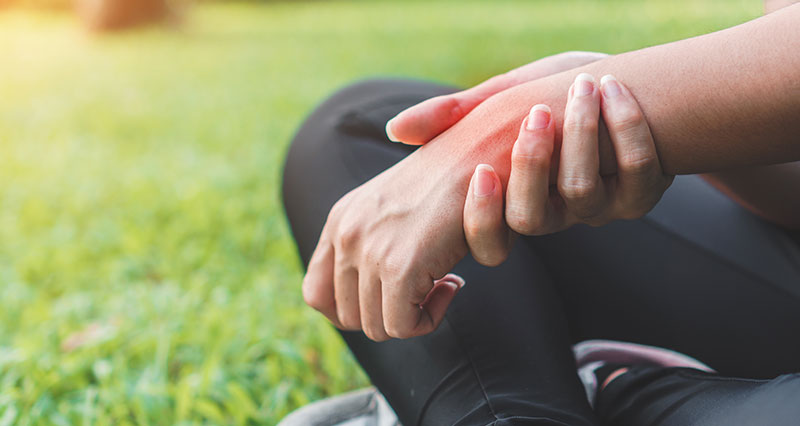
Finger sprains
A sprained finger occurs when the finger is bent causing damage to the ligaments which connect bones together. It is a common injury in ball games such as netball, American football, basketball, cricket, handball etc. Symptoms include pain in the finger at the time of injury with swelling likely to develop over the joint and restricted movement in the finger. Later on, pain is likely to be more specific when bending the finger. Read more on treatment for finger sprains.
Rotator cuff injuries
A rotator cuff strain is a tear to any of the four rotator cuff muscles in the shoulder and is common in throwing and racket sports. They are so-called because their job is to rotate the arm at the shoulder and provide a supportive cuff around the joint. Treatment consists of reducing pain and inflammation followed by a full rehabilitation program consisting of mobility, strengthening, and sports-specific exercises. Read more on the treatment and rehabilitation of rotator cuff strain.
Ankle Sprain
A sprained ankle is one of the most common sports injuries and is also the most frequently re-injured. In the majority of cases, the ankle rolls inwards (inversion) under the weight of the rest of the body, resulting in damage to the ligaments on the outside of the ankle. Read more about treatment and prevention of ankle sprains.
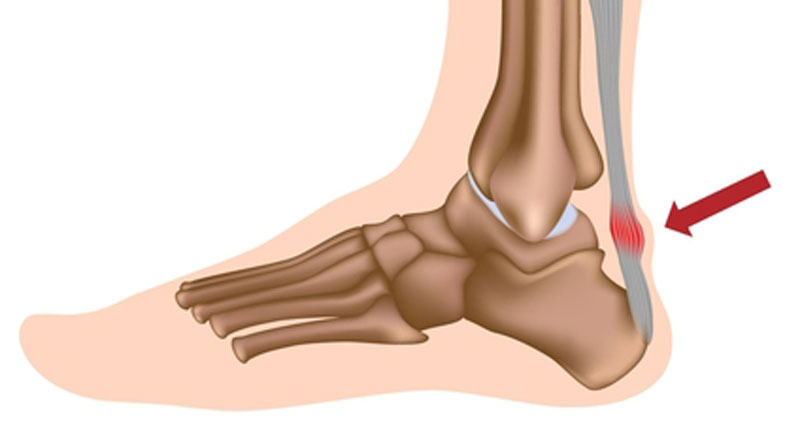
Achilles tendonitis
Achilles tendonitis (also known as Achilles tendinopathy or Achilles tendinosis) is an overuse injury causing pain, inflammation, and or degeneration of the Achilles tendon at the back of the ankle. If this type of injury is not caught early this can be difficult to cure but with the right treatment and particularly eccentric strengthening exercises, a full recovery can usually be achieved. Read more on treatment and rehabilitation of Achilles tendonitis.
Jumpers knee
Jumper’s knee or patellar tendonitis is an overuse injury that results in pain at the front of the knee, localised at a point towards the bottom of the kneecap. Repetitive strain from too much running or jumping causes inflammation or degeneration of the patella tendon. Patellar tendonitis can be a tricky condition to treat and requires a substantial period of rest and a thorough treatment and rehabilitation program. Read more on the causes and treatment of Jumper’s knee.
Medial knee ligament sprain
Medial ligament sprain or MCL injury is a tear of the ligament on the inside of the knee, it is usually a result of direct impact or twisting motion. A medial ligament injury is common in contact sports such as football and rugby, as well as martial arts. They can also occur in daily life through falls and twists of the knee joint. Read more on the treatment and rehabilitation of medial ligament sprain.
Hamstring strain
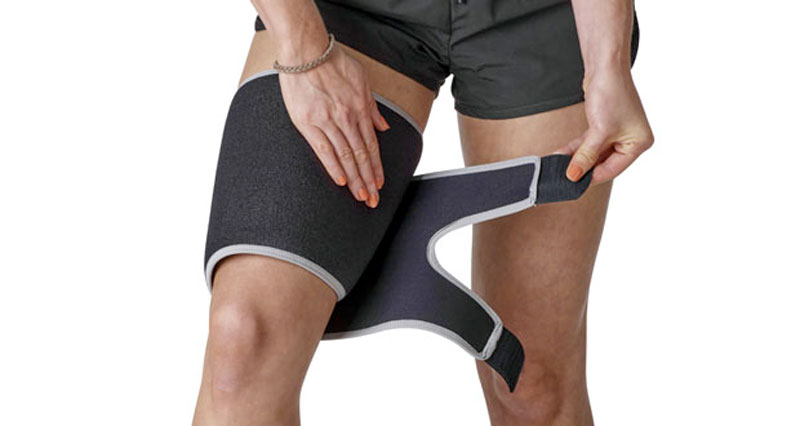
Hamstring strain commonly known as a pulled hamstring is sudden sharp pain at the back of the thigh. Treatment for this injury involves immediate first aid of rest, ice, and compression followed by a full rehabilitation and exercise program. Symptoms of a hamstring strain include pains whilst sprinting or a fast stretching movement or a high kick. Read more on the treatment of hamstring strains.
Shin splints
Pain at the front of the lower leg is commonly referred to as shin splints. Usually, symptoms occur at the front inside of the shin bone but can arise from a number of causes. We explain the symptoms, treatment, and rehabilitation of medial tibial stress syndrome to cure and prevent it from recurring. Read more on how to prevent and treat shin splints.
Should I seek professional treatment?
If you have suffered a basketball injury with any of the following symptoms you should seek further medical assistance.
- Severe pain, especially on walking
- Severe swelling (oedema)
- Altered sensation in the foot – such as a feeling of “pins and needles” (paresthesia) or a “loss of feeling” (anaesthesia).
- Unable to complete normal daily activities after the initial 72 hours.
Further medical assistance can be sought through either your local GP or a private clinician such as a podiatrist, physiotherapist, sports therapist, osteopath or chiropractor. If you have followed the P.R.I.C.E. principles (see below) and are still unable to walk after 72 hours or still have severe pain that is not subsiding after the first 72 hours you should visit your local A&E department for further assessment.
Secondly, if you have applied for P.R.I.C.E. principles and still have weakness that lasts a long time (more than 2 weeks) or have ongoing discomfort in your foot or heel, you are highly recommended to seek advice from a specialist expert – such as a podiatrist or physiotherapist, osteopath, or chiropractor – who can provide you with advice and an appropriate and effective recovery and rehabilitation program.
Immediate first aid for acute basketball injuries
The PRICE principles are the gold standard set for treating acute sports injuries. The acronym stands for Protection, Rest, Ice, Compression and Elevation and should be applied as early as possible and continued for at least the first 24-72 hours.
Protection of the damaged tissue is vital to prevent further damage and enable the healing process to start efficiently and effectively. There are a number of ways to protect the injured area all with the same aim of limiting further movement and use of the joint/ muscle/ligament/tendon. One way this can be achieved is by using a support or splint.
Rest – in the early stages, rest is one of the most important components of the P.R.I.C.E principle but is often neglected or ignored. It does not only refer to the prolonged period of time that the athlete will be out of action but also to the immediate period after the injury.
An athlete must know when to stop training and allow the injured area to heal otherwise repetitive minor injuries can often result in a more severe injury that keeps the athlete out for much longer.
If an injury is sustained during sporting activity some athletes have a tendency to ‘run it off’. This implies that by continuing to participate in the exercise, the injury will simply go away. In fact, in the majority of cases, this is not true and is not advisable.
Ice therapy, also known as cryotherapy, is one of the most widely known and used treatment modalities for acute sports injuries. It is cheap, easy to use and requires very little time to or expertise to prepare.
The application of ice to an injury, in the acute phase, can substantially decrease the extent of the damage. It achieves this in a number of different ways:
- Decreases the amount of bleeding by closing down the blood vessels (called vasoconstriction).
- Reduces pain (pain gate theory)
- Reduces muscle spasm
- Reduces the risk of cell death (also called necrosis) by decreasing the rate of metabolism
Ice is usually applied to the injured site by means of a bag filled with crushed ice which is wrapped in a damp towel. The damp towel is essential as it forms a barrier between the bag of ice and the skin and reduces the risk of an ice burn.
DO NOT leave the ice on for more than 15 minutes as you could cause an ice burn.
There are a small number of areas that you should not apply ice to which include the neck, the outside bone of the elbow, the collarbone (upper end), the front of the hip (bony part) and the outer bone of the knee. The reason for this is there is a superficial nerve just below the skin in these areas that can be damaged by applying ice to it. Always check for contraindications.
Compression – applying compression to an injured area minimises the amount of swelling that forms after an injury in two ways and should be applied for the first 24 to 72 hours from the onset of injury. Compression can be applied through a number of methods. The most effective of these is by using a compression bandage which is an elasticated bandage that simply fits around the affected limb.
Elevation of the injured limb is the final principle of PRICE but is equally as important as the other 4. Elevation allows gravity to drain the fluid away from the injured site. This aids in decreasing the swelling which in turn may decrease the pain associated with the oedema (swelling).
Read more on PRICE principles