Here we outline some simple stretching and strengthening exercises for treating Patellofemoral pain syndrome.
We recommend seeking professional advice before beginning rehabilitation.
Aim of Patellofemoral pain syndrome exercises
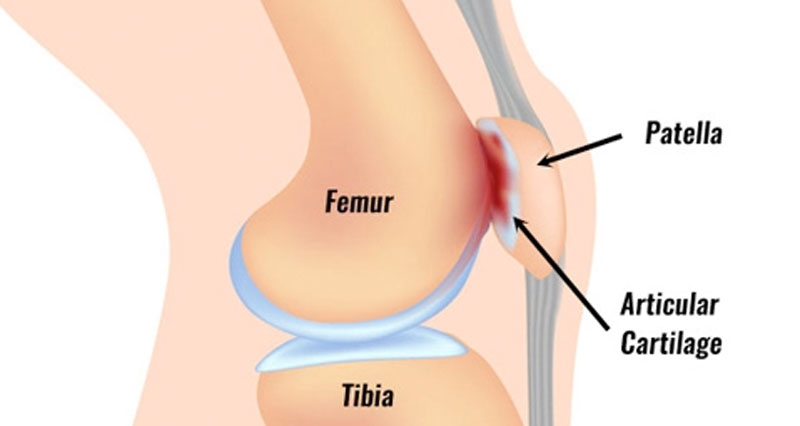
The aim of Patellofemoral pain syndrome exercises is to correct tracking of the patella as the knee bends.
Most commonly the patella tracks outwards (laterally) so the muscles on the inside of the thigh need strengthening.
Stretching exercises for Patellofemoral pain
The tight structures of the knee such as the lateral retinaculum need to be stretched and mobilized.
Patella glides
Teaching point:
- With the knee slightly bent.
- Glide or pulled your patella towards the inside of your knee.
- Hold for 20 to 30 seconds.
Quadriceps stretch
Teaching point:
- Hold the foot of the leg to be stretched and gently pull up behind.
- It can be done in the standing position (most common) or lying down as shown.
- Aim to keep the knees together and pull the leg up straight not twisted.
- The athlete should feel a stretch at the front of the leg – It should not be painful.
- Hold stretches for 20-30 seconds.
- Repeat 3-5 times.
Important – if this stretch is painful for the knee then do not do it.
Iliotibial band stretch
Teaching point:
- Place the leg you want to stretch behind the other one.
- Put your weight onto your back leg, and hold onto something to lean on if necessary.
- Hold for 20-30 seconds, repeat 3-5 times, and do this at least three times a day.
Long adductor stretch
Teaching point:
- To stretch the long groin muscles which cross the knee joint stand with the feet wide apart.
- Bend the knee that you don’t want to stretch and lean away from the one you are stretching.
- Hold for 20-30 seconds and repeat 3-5 times, at least 3 times a day.
Short adductor stretch
Teaching point:
- To stretch the short groin muscles sit on the floor with the soles of your feet together.
- Place your elbows on the inside of your knees and gently press down until you feel a stretch.
- Hold for 20-30 seconds, rest, and repeat 3-5 times, 3 times a day.
Strengthening exercises for Patellofemoral pain
Exercises can usually begin as soon as they can be performed without pain. The aim of patellofemoral pain exercises is to encourage normal patella tracking. In particular, to strengthen the muscles on the inside of the knee (vastus medialis obliques), as well as the gluteus medius muscle on the outside of the hip.
Isometric quadriceps
This exercise is more suitable if you have pain and are unable to perform standing exercises.
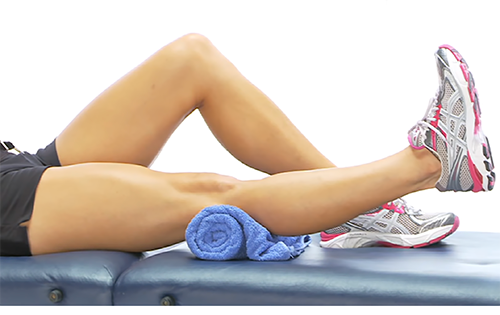
Teaching point:
- Sit on the floor with a foam roller or rolled-up towel under the knee so that it is slightly bent.
- Place your hand on your
vastus medialis muscle (just above and to the inside of the knee cap). - This is so you can feel it contracting.
It is essential you learn to isolate the vastus medialis muscle (VMO) and feel it working for strengthening to be effective. Turning the foot outwards may increase the load on the VMO.
A muscle stimulator or tens machine can help in the early stages.
- Contact the muscles, hold for 3 to 5 seconds, relax and repeat 10 times.
- Your foot should lift up off the floor as your knee straightens.
- These exercises should be performed 3 to 5 times a day if pain allows.
- More on VMO strengthening
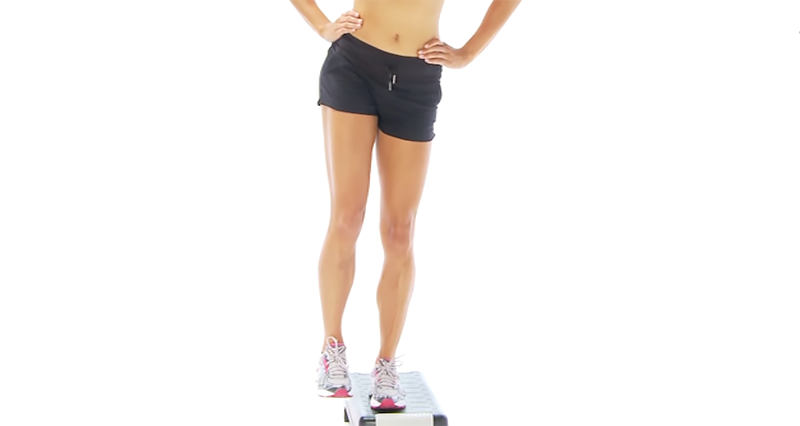
Heel drop exercises
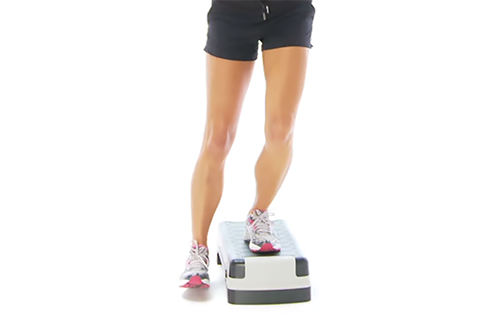
A more advanced exercise than a static contraction. Again it should be emphasized that the knee should be kept pointing forwards throughout the exercise and the athlete should be aware that it is the vastus medialis on the inside that is working.
- Drop down off the step as far as is comfortable (this does not always need to be all the way down) and return to the starting position.
- Repeat 10 times and aim to perform a number of sets throughout the day.
Clam
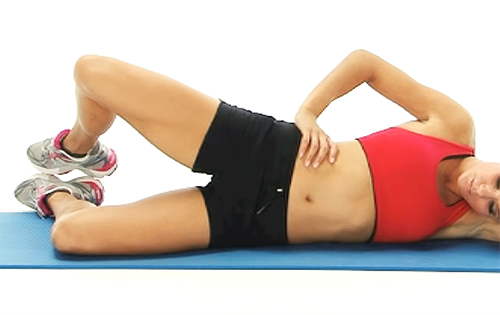
Teaching point:
- Lay on your side with the knees bent to 90 degrees and feet in line with your spine.
- Lift the top knee away from the bottom knee. Make sure you keep the lower back and pelvis still and don’t rock backward.
- You should start to feel the Gluteus Medius muscle at the back, the top of the hip working.
- Start with 2 sets of 10 repetitions and gradually increase to 3 sets of 15-20.
Lunge
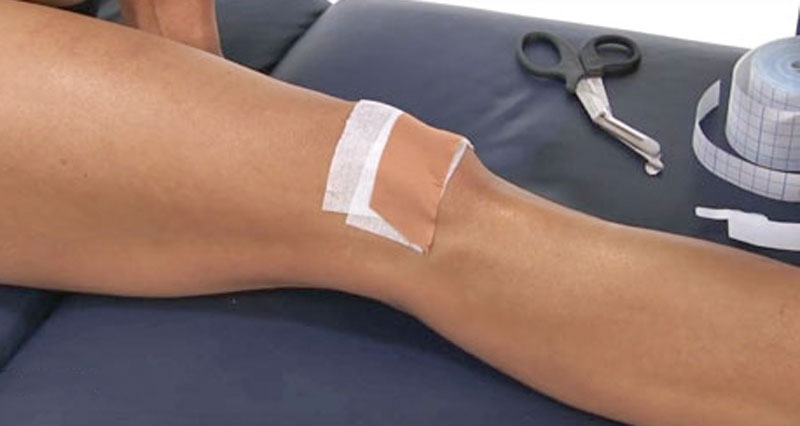
This exercise should be started as soon as pain will allow. Tape the knee if necessary to avoid pain.
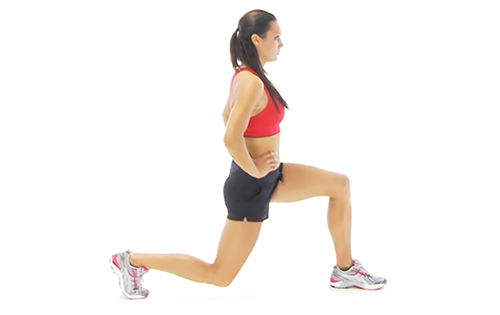
Teaching point:
- Stand one foot in front of the other, the injured knee forwards.
- Bend the front knee enough to feel the
vastus medialis is working. - Aim to keep the knee pointing forwards – don’t let it fall inwards.
- Return to starting position and repeat. Aim for 3 sets of 10 repetitions.
Again it may be better to perform a number of sets throughout the day, especially in the early stages of rehabilitation or for a particularly weak muscle.