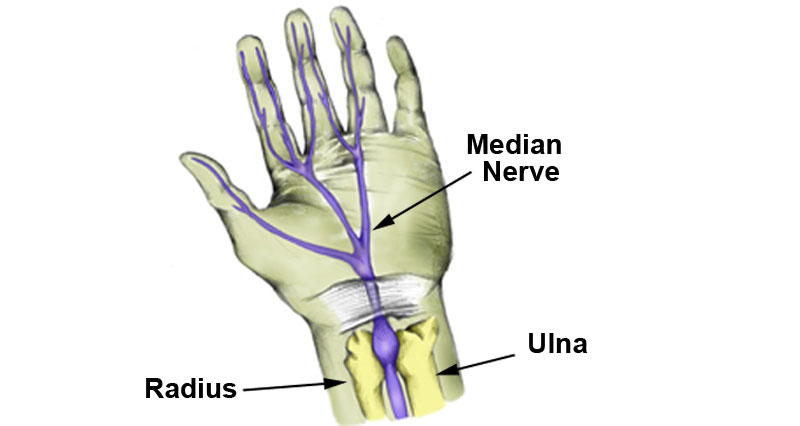
Carpal tunnel syndrome exercises are done following a period of immobilization to aid recovery. Here we explain the stretching and strengthening exercises that are important to help prevent your symptoms from returning.
Advert
When should I begin exercises for Carpal tunnel syndrome?
- Begin exercises as soon as you can do them pain-free
- If pain occurs, go back a step or rest for longer
- Initially, mobility and gentle stretching exercises should be done to restore a full pain-free range of motion at the joint
- Later static strengthening exercises that do not involve movement
- Finally, normal strength is restored by dynamic exercises involving movement with resistance bands or dumbbell weights
Carpal tunnel stretching exercises
Exercises to stretch the muscles surrounding the wrist can help to ensure the tendons which pass through the carpal tunnel are in good condition. Tendon injuries can sometimes cause carpal tunnel syndrome.
Wrist extensor stretch

- Very gently bend the wrist forwards (i.e. so the fingers point downwards)
- Use the other hand to apply some pressure
- Start off doing this with the elbow bent.
- Progress to performing with the elbow straight (use a wall for overpressure if your other hand doesn’t reach!)
- Hold the stretch for 10-20 seconds and repeat twice
- Stretch 2-3 times a day and continue this throughout your rehabilitation program
Wrist flexor stretch

- Gently bend the wrist so the fingers point upwards
- Again start with the elbow bent and apply some pressure with the other hand to feel a stretch on the underneath or inside of the arm
- Progress this exercise gradually over time to perform it with the arm straight
- Hold for 10-20 seconds and repeat twice
Carpal tunnel strengthening exercises
Isometric carpal tunnel wrist exercises

- Start with isometric exercises which involve contracting the muscles against resistance, without movement
- These are very low-level exercises that should be used at the first point of strengthening
- Make a fist with your affected hand. Place the other palm on top of your hand (near the knuckles)
- Try to extend your wrist (bend it back), using the hand on top the resist the movement
- Hold each contraction for between 5 & 10 seconds, gradually increasing as required. Perform between 5 & 10 reps
- Do the same with wrist flexion – use the good hand to apply resistance as you try to flex the wrist
- Once you can achieve 10 reps of 10- second holds without any negative effects (either immediately or over the next 24 hours), move on
Wrist extension
- Dynamic exercises are those which involve movement such as when using a dumbbell
- These are more difficult than isometric exercises
- Perform wrist extension using either a dumbbell (1-2kg) or a resistance band
- Make sure the forearm is supported on a table, bench, or even your lap
- Perform slowly and under control
- Start with 10 repetitions and gradually increase up to two sets of 20
- Do the same with wrist flexion – turn the wrist over so the back of the arm/wrist is resting on a table or bench and curl the wrist up towards you
Wrist flexion
- Exactly the same is done as for the wrist extension exercise above except the wrist and arm are the other way up
- The palm is facing upward and the exercise is performed in a slow and controlled manner
- Start with 10 repetitions and gradually increase up to two sets of 20
- Do the same with wrist flexion – turn the wrist over so the back of the arm/wrist is resting on a table or bench and curl the wrist up towards you
References
- Dincer U, Caker E, Kiralp MZ, et al. The effectiveness of conservative treatments of carpal tunnel syndrome: splinting, ultrasound, and low-level laser therapies. Photomed Laser Surg 2009;27(1):119-25.
- Popescu S, Poenaru D, Galbeaza G, et al. Conservative treatment for carpal tunnel syndrome. Journal of clinical medicine 2008:249-53.