
Jumper’s Knee Rehabilitation
A step-by-step rehabilitation program for Jumper’s knee/Patella tendonitis. Criteria-based, we take you from initial injury to full competition fitness.
Progress through 4 phases at your own pace, meeting specific criteria before moving on.
Available on:


Suitable for:
Jumper’s knee/Patella tendonitis
Level
From beginner to elite level
Time required:
10 – 20 mins daily
Play video
Introduction to the program
We don’t just aim to heal your injury with this program but enable you to come back even stronger than before.
We include mobility & stretching, strengthening, movement control, functional and activation exercises to prevent loss of fitness and function whilst recovering.
It is also suitable for those who may have recovered from Patella tendonitis but wish to go further with their rehab to help prevent future injuries.
What’s included?
Treatment & healing
This covers how and when to apply treatment such as cold therapy & compression, heat, massage, taping & bracing.
Exercises
Over 60 different exercises with video demonstrations covering mobility & stretching, activation, strengthening, motion control/proprioception, and functional.
Criteria based
Progress through the program at your own pace regardless of how severe or recent your injury is. You need to meet specific ‘Exit Criteria’ before you can progress to the next phase.
Priority support
If you have any questions about the program or your progress then get in touch with our qualified sports therapist for advice.
Meet the program physiotherapist
Paul Tanner
Paul is head of Medical Services at Millwall Football Club, dealing with all aspects of match and training day sports physiotherapy and medical cover.
His career also includes First Team Physio at Norwich City Football Club and Senior physiotherapist to London Wasps Rugby first-team squad.

Go mobile!
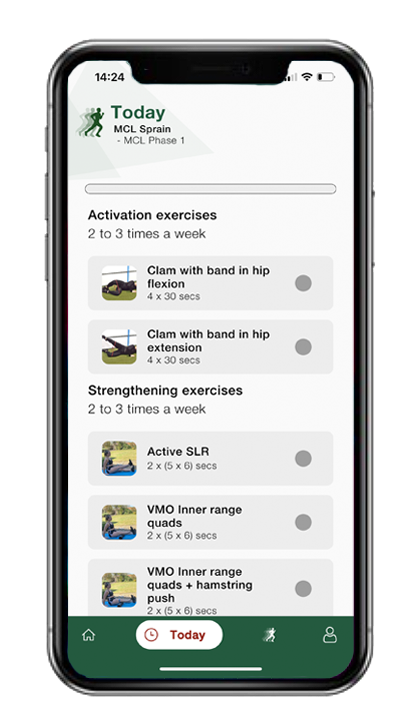
Our sports injury rehabilitation mobile app tells you what treatment and exercises to do each day and tracks your progress.
- Video based programs
- Set alerts & reminders
- Records daily progress
Download now!
Program content & structure
The program consists of 4 phases:
Phase 1
Phase 1 begins as soon as possible following injury. The aim of phase 1 is to reduce pain and inflammation.
Phase 2
The aim of phase 2 is to gradually increase the load through your knee. As you improve you should increase the speed of the downwards phase of knee exercises.
Phase 3
The aim of phase 3 is to further increase the load through the patella tendon and begin to introduce plyometric exercises.
Phase 4
This is the eccentric loading phase where you can begin to really strengthen your knee and start to return to normal training.
Sign up now!
A step by step rehabilitation program for Jumper’s knee/Patella tendonitis. Criteria based, we take you from initial injury to full competition fitness. Learn more about Patella tendonitis