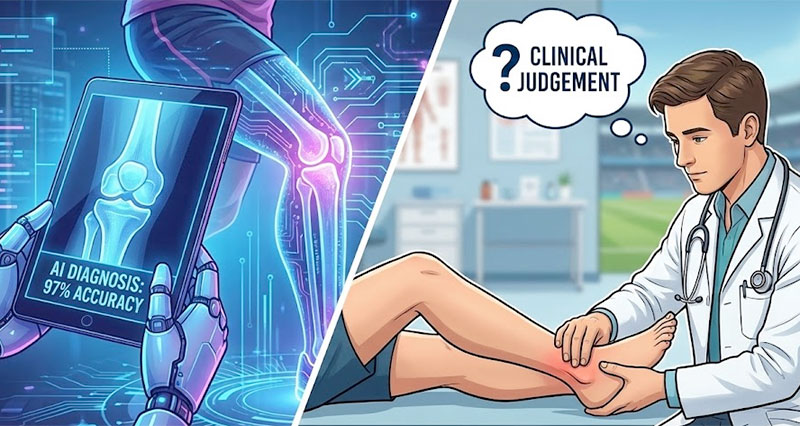
Artificial intelligence is becoming increasingly common in healthcare, but how accurate is it when it comes to diagnosing sports injuries? The answer: very good in some areas, helpful in others, and not yet a replacement for a qualified clinician.
This article breaks down where AI performs well, where it struggles, and how it is currently being used in sports injury assessment.
AI Is Excellent at Diagnosing Injuries From Medical Imaging
AI has made the biggest impact in X-ray, MRI and ultrasound interpretation. Because these tasks are pattern-recognition based, machine learning systems excel at spotting abnormalities.
Recent studies show AI can achieve:
- 94–97% accuracy in fracture detection
- Radiologist-level performance for ACL tears, meniscus tears, rotator cuff tears, and bone stress reactions
- Better consistency than humans in identifying small or subtle findings
In many hospitals, AI now pre-screens scans before a radiologist reviews them, helping flag urgent cases faster.
Where it performs best:
- Broken bones
- Joint effusion
- Tendon tears
- Stress fractures
- Cartilage defects
Bottom line:
AI is already highly reliable for identifying structural injuries when imaging is available.
AI Is Moderately Helpful for Symptom-Based Diagnosis
If you type in your symptoms to an AI system e.g., “tight calf after running, mild swelling, sharp pain when pushing off”—it can give a reasonable shortlist of possible conditions.
However, accuracy varies because:
- Many injuries have overlapping symptoms
- Pain descriptions are subjective
- Mechanism of injury is often unclear
- AI cannot perform palpation, special tests or movement assessments
AI tends to suggest several potential diagnoses rather than a definitive answer.
Useful for:
- Early triage
- Understanding possible causes
- Deciding whether you need professional assessment
Not reliable for:
- Confirming the exact structure injured
- Determining severity
- Identifying red-flag conditions without detailed input
Bottom line:
AI is a helpful guide, but not a standalone diagnostic tool.
AI Still Struggles With Complex or Multi-factor Injuries
Certain injuries require nuanced, hands-on clinical reasoning. AI currently performs poorly with:
- Low back pain
- Hip/pelvis issues
- Chronic tendinopathy
- Nerve irritation or compression
- Multi-site or overuse injuries
- Conditions influenced by psychology, lifestyle or loading history
These injuries require:
- Physical testing
- Assessment of movement patterns
- Patient history
- Load analysis
- Objective measures that AI cannot gather on its own
Bottom line:
For complex presentations, AI is not yet close to physiotherapist-level assessment.
Movement Analysis: Useful but Not Diagnostic
AI can analyse video of running, jumping or cutting movements.
This is helpful for:
- Gait analysis
- Knee valgus tracking
- Landing mechanics
- Identifying possible risk factors
But it cannot diagnose:
- What tissue is injured
- Whether pain is structural or functional
- The underlying cause without context
Think of it as a performance tool, not a medical diagnostic system.
How Clinicians Are Using AI Today
In 2025, AI is commonly used to:
- Screen medical images and flag abnormalities
- Prioritise urgent findings (e.g., suspected fractures)
- Track movement patterns over time
- Support clinical decision-making
- Generate rehab plans or patient education materials
- Build personalised injury-risk profiles using wearable data
Importantly, clinicians use AI as decision support, not a replacement.
Will AI Fully Diagnose Injuries in the Future?
We are moving toward more capable systems that combine:
- Symptoms
- Medical history
- Imaging
- Wearable data
- Movement patterns
- Machine learning models trained on millions of cases
When these systems mature, AI could achieve near-clinician accuracy, especially for common injuries.
However, diagnosis will likely remain a human + AI partnership, not AI alone.
Sports injuries are too variable, contextual and dependent on real-world testing.
Conclusion
AI is already transforming injury diagnosis—especially in imaging, where it performs at or above specialist level.
But for most sports injuries, especially those not confirmed by imaging, AI should be considered:
- A helpful guide
- A triage tool
- A supplement to clinical assessment
AI improves speed, consistency and access to information, but the judgement, experience and hands-on skills of a trained physiotherapist or sports doctor remain essential.