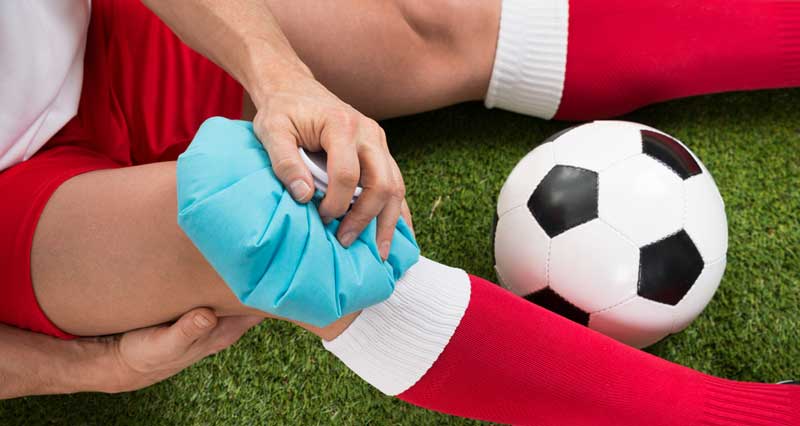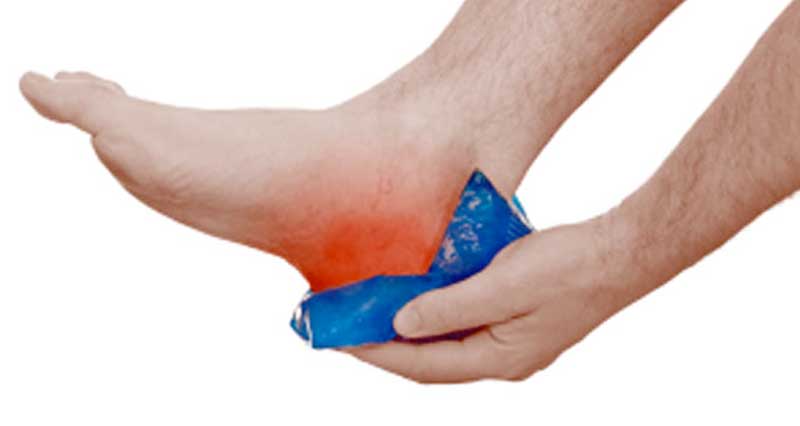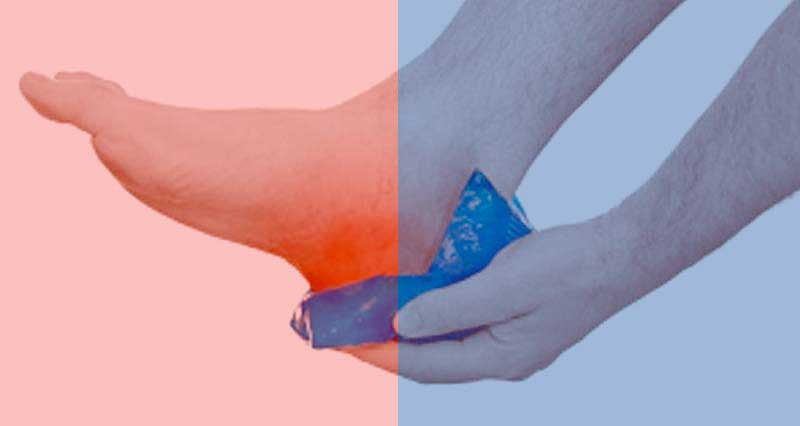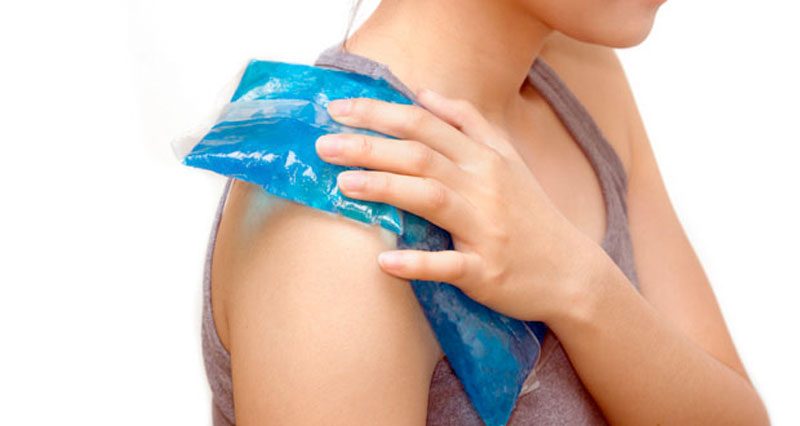
Cold therapy (cryotherapy) is the application of ice or cold packs to treat sports and soft tissue injuries.
When damage occurs to soft tissue, such as when muscle tears, blood vessels may rupture within the muscle and the injury site begins to bleed internally.
What is the PRICE principle?
The P.R.I.C.E. principle involves all the components required to prevent further injury and start the healing process. If applied early enough and correctly it can significantly reduce the recovery time of the athlete. Reminder: The letters P.R.I.C.E. are abbreviations for:
- P – Protection
- R – Rest
- I – Ice
- C – Compression
- E – Elevation
Apply PRICE as early as possible after the injury and continue for at least the first 24-72 hours.
What Happens in the Early Stages of a Soft Tissue Injury
Each component of the P.R.I.C.E. principle plays an important role in limiting swelling and decreasing pain. As a result, the healing process is speeding up.
An increase in blood volume in the area can cause cell death (secondary hypoxic injury). Therefore, make every effort to control excessive bleeding.
The inflammation process
Secondary to this, the human body’s response to injury is to start the repair process immediately by protecting the damaged tissue. It does this by increasing pain and swelling and producing a fluid called exudate fluid. The exudate fluid carries all the cells and chemicals in the area to repair the damaged tissue (the body’s own emergency services!).
Damaged cells release a chemical that starts this process and it is essential for healing. However, recovery times are shorter if you can limit this. This is the inflammation process and is vital for tissue healing.
Protection
Protection of the damaged tissue is vital to prevent further damage and enable the healing process to start efficiently and effectively. There are a number of ways to protect the injured area all with the same aim of limiting further movement. One way to achieve this is by using a support or splint.
Rest
In the early stages, one of the most important components of the cold therapy P.R.I.C.E principle is rest. Often ignored, rest not only refers to the time the athlete is out of action but the acute period immediately after injury.

You must know when to stop training and allow the injured area to heal, otherwise, repetitive minor injuries often result in more severe injuries. As a result, keeping you out for much longer. Prevent this by resting properly immediately after injury.
Athletes with sports injuries have a tendency to try and ‘run it off’. This implies that by continuing to participate in the exercise, the injury will simply go away. In fact, in the majority of cases, this is not true and is not advisable.
Pain gate theory
In some cases, continuing to exercise reduces pain. This is because during exercise, nerve impulses sent due to mechanical stress, such as touch, override the impulses from the pain nerves. This is the ‘pain gate theory’. A good example of this is rubbing an injured area can often make it feel better initially.
In addition to physiological factors (nerve overriding), the player’s mentality and the presence of adrenaline all play a part in over-riding the pain from the injury.
However, pain often returns once activity ceases. This is because the tissue itself is still damaged. The continued activity could, in fact, cause serious further injury (as mentioned earlier).
Complete rest vs active rest
There are a number of different degrees of rest and this depends on the severity of the injury and the type of tissue damaged. For example, if you have a severe ankle sprain and cannot walk properly, you need complete rest.
However, a minor “tweak” of a muscle only requires modified activity, i.e. no action that uses the injured muscle.
Ice
Ice therapy, cold therapy, or cryotherapy, is one of the most widely used treatment modalities for acute sports injuries. It is cheap, easy to use, and requires very little time or expertise to prepare. The application of ice to an injury, in the acute phase, can substantially decrease the extent of the damage. It achieves this in a number of different ways:
- Decreases bleeding by closing down the blood vessels (called vasoconstriction).
- Reduces pain (pain gate theory)
- Muscle spasm is reduced
- The risk of cell death (also called necrosis) is reduced. This is because the rate of metabolism is reduced.
Read more on the benefits of cold therapy.
Applying cold therapy & ice burns
Ice is usually applied to the injured site by means of a bag filled with crushed ice which is wrapped in a damp towel. The damp towel is essential as it forms a barrier between the bag of ice and the skin and reduces the risk of an “ice burn”. DO NOT leave the ice on for more than 15 minutes as you could cause an “ice burn”. A more detailed overview of the correct use of ice therapy and the indications for its use are available on the application page.
There are a small number of areas where you should not apply ice for various reasons. These are the neck, the outside bone of the elbow, the collarbone (upper end), the front of the hip (bony part), and the outer bone of the knee. The reason for this is there is a superficial nerve just below the skin in these areas that can be damaged by applying ice to it. Cold therapy should also not be applied to the area of the kidneys which is just below the ribs towards the back. If in any doubt, consult a professional.
Compression
Applying compression to an injured area minimises swelling that forms after an injury in two ways and should be applied for the first 24 to 72 hours from the onset of the injury.
How does compression help?
The first way is compressing the injured limb increases the pressure within the tissue thus narrowing the blood vessels (vasoconstriction) and preventing excessive bleeding.
The second way is moderating the amount of fluid that the body produces to protect the injured tissue, called an exudate. Although exudate carries the chemicals and cells that help repair the damaged tissue, moderating the amount will significantly reduce the overall healing time.
Applying compression
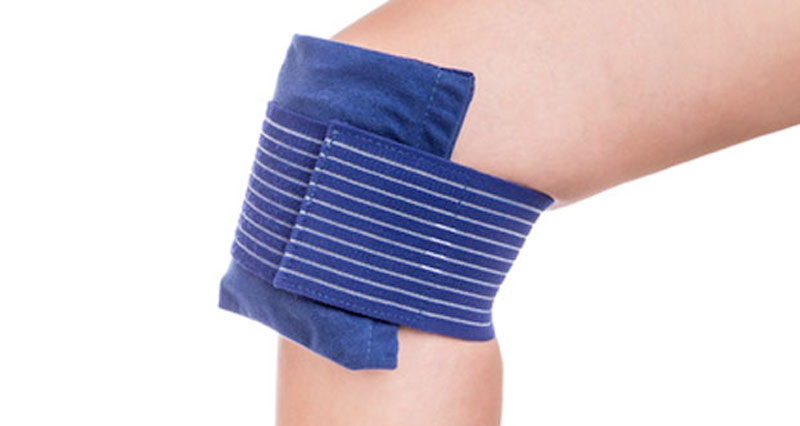
Compression can be applied through a number of methods. The most effective is a compression bandage. This is an elasticated bandage that simply fits around the affected limb.
The advantages of the compression bandage are that it is easy to apply. Elastic provides sufficient pressure to stop bleeding as soon as possible, whilst also allowing your injured limb to swell slightly.
This is very important because if compression is too tight, further tissue damage occurs, such as cell death (necrosis). An excellent way to monitor whether a bandage is too tight is to check the sensation in the tissues on either side of the bandage. For example, check for ‘pins and needles’ sensation or skin discolouration/coldness in the toes when compressing an ankle. This is a sign that the bandage is too tight. If this is the case, loosen their bandage or remove the bandage completely if the feeling/discolouration does not resolve immediately.
Apply bandages lower and work upwards
Bandaging should always begin distal (furthest away from the heart) to the injured site with each layer overlapping the underlying layer. For example, if you are compressing a thigh, start at the knee and work up towards the hip whereas if you are compressing an elbow, start at the forearm and work up towards the upper arm. The reason for this is to encourage the swelling to move back towards the heart/centre of the body and be reabsorbed. Ideally, compression should be combined with ice therapy and applied with the ice pack itself, either manually or by wrapping the ice pack in a bandage.
Elevation
Elevate the injured limb. This is the final principle of cold therapy PRICE but is equally as important as the other 4. Elevation allows gravity to drain the fluid away from the injured site. This aids in decreasing the swelling which in turn may decrease the pain associated with oedema (swelling). In lower limb injuries, try and keep the ankle elevated above the level of the hip, and in upper limb injuries, keep the arm elevated in a sling or rested on a pillow. Attempts to keep the limb elevated whenever possible should continue for at least the first 48 hours.
Recommended further reading and updates on PRICE:
- Updates on PRICE – Br J Sports Med 2012;46:220-221 doi:10.1136/bjsports-2011-090297
- What is the evidence for PRICE? – J Athl Train. 2012 Aug; 47(4): 435–443.