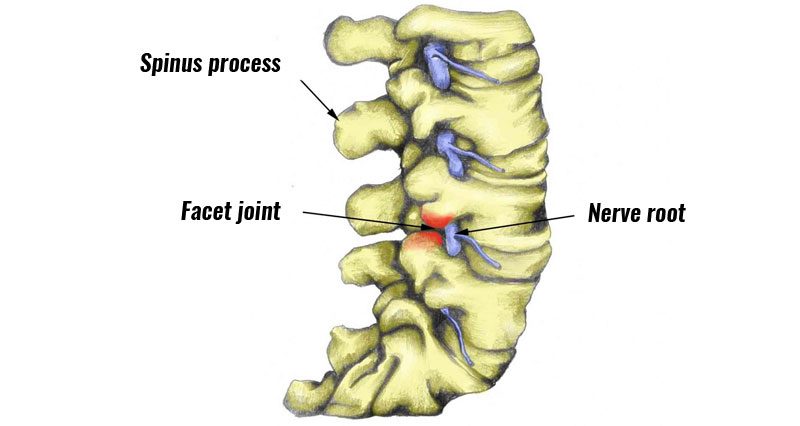
Facet joint pain is a cause of pain in the back. The facet joints or zygapophysial joints are synovial joints between individual vertebrae of the spine.
Symptoms of Facet Joint pain
Common symptoms associated with facet joint pain include muscle spasms which pull the spine out of alignment causing back pain.
Often patients report just bending over to tie a shoelace for example then suddenly being unable to move. The usual acute attack of back pain involving facet joints occurs suddenly with no warning.
Diagnosis
Usually, your doctor can see facet joint damage on plain X-rays which are taken:
- Front to back
- Side to side
- Obliquely across the joint
In some cases, a CT scan is used instead. This shows more detail of other structures.
If your doctor doesn’t find anything, then they may do an MRI scan. This shows possible prolapsed discs or ligament sprains.
Another method sometimes used is an injection into the facet joint itself, sometimes called a facet joint block. The injection consists of x-ray contrast material, local anaesthetic, and cortisone. If this eases the symptoms then this is considered diagnostic of facet joint dysfunction.
What is Facet joint pain?
The facet joints or zygapophysial joints are synovial joints. They help support your spine and control movement between individual vertebrae. The facet joints work together with the intervertebral discs to enable the spine to move.
The ends of the bone are covered with smooth, hard cartilage called articular cartilage. This, along with the joint capsule provides stability and enables movement.
Facet joints have a nerve supply from two levels, one branch arises from the nerve root at that level and the second from the level above. When functioning correctly, facet joints move freely controlling the movement of the spine.
Facet joint pain may arise directly from the facet joint either from inflammation or nerve impingement. This spasm of adjacent muscles is the body’s way of protecting the area and tries to prevent you from moving and incurring more damage.
Symptoms can vary greatly and be confused with disc-related disorders as it’s possible for patients to report referred pain in the lower extremities. The traditional facet locking syndrome may lead to such an acute attack but can be resolved successfully by freeing the offending joint and restoring normal function.
Treatment of Facet Joint Syndrome
There are a number of treatment options available, of which some may work better for some people whereas others prove more effective for someone else.
Initial (acute) treatment
- Rest and get in the position which is most comfortable and try not to stress it further.
- Some therapists will recommend cold therapy and some prefer hot packs.
- Whatever seems to offer the most relief is fine. Use this for 15 minutes at a time every couple of hours.
- Anti-inflammatory medication such as ibuprofen may be helpful.
- Try not to follow outdated advice to rest flat on your back for a week! It is better to try to get some gentle movement going within a day or so.
Further treatment
- After the acute stage has passed, treatments such as sports massage may help to ease associated muscle spasms.
- Chiropractic mobilization may be helpful to free stiff joints and allow better movement but should only be done by a qualified professional.
- Exercises to improve posture and strengthen the back and core muscles may be helpful.