MCL Sprain Exercises
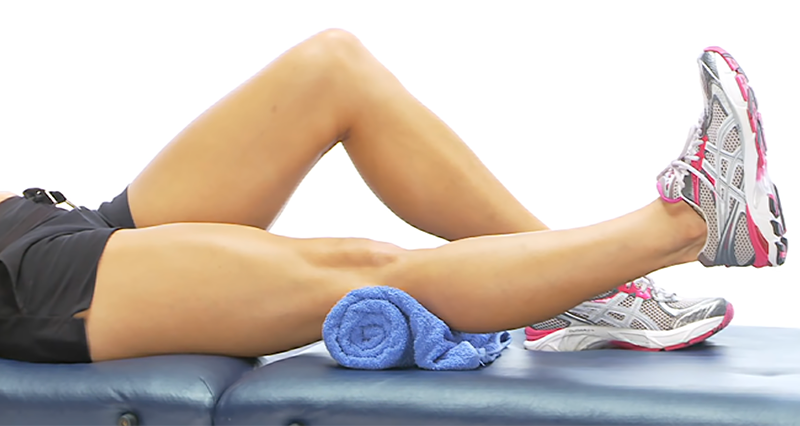
MCL sprain exercises help restore movement, strength, stability, and confidence in the knee. Rehabilitation should progress from early mobility work through to strengthening, balance, and sport-specific exercises.
Medically reviewed by Dr Chaminda Goonetilleke, 13th Dec. 2021
Our MCL sprain rehabilitation program guides you step by step from injury to full fitness, with clear daily exercises and progressions.
We always recommend seeking professional advice before starting any medial ligament strengthening exercises.
MCL sprain mobility exercises
Begin mobility exercises as soon as pain allows. The aim is to restore a full, pain-free range of movement and prevent stiffness in the knee.
Heel slides
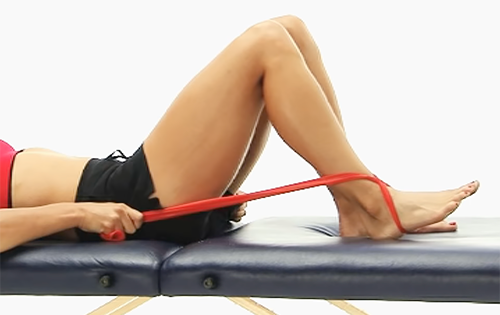
Teaching points:
- Lie on your back.
- Slowly slide your heel towards your buttocks.
- Use a towel or strap around your ankle to increase the range of movement.
- Do not force the movement, especially in the early stages or if you feel pain.
View our full MCL rehab program for more exercises
MCL sprain strengthening exercises
Begin strengthening exercises as soon as pain allows. Start with isometric (static) contractions before progressing to more dynamic movements as strength improves.
Isometric quads contractions
Begin this exercise as soon as pain allows. You can perform it daily.
In some cases, you can continue this exercise even if your knee is immobilised in a brace or cast.
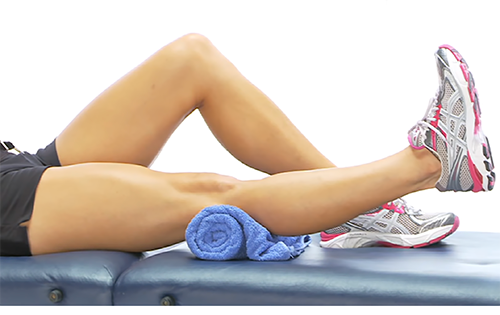
Teaching points:
- Tighten your quadriceps muscles at the front of your thigh.
- Hold for 10 seconds.
- Relax for 3 seconds.
- Repeat 10 to 20 times.
- Place a rolled towel or foam roller under your knee to increase activation.
Calf raises
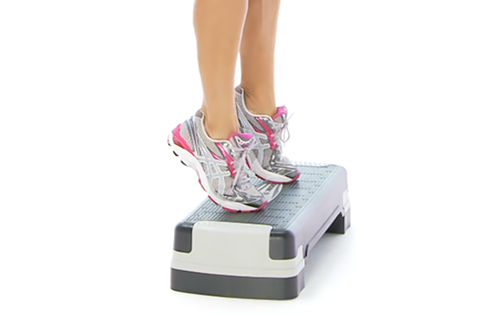
Teaching points:
- Stand with your feet shoulder-width apart and hold onto something for balance.
- Raise your heels as high as possible off the floor.
- In the early stages, perform the exercise using both legs.
- Slowly lower your heels back down under control.
- Aim for 2 to 3 sets of 15 to 20 repetitions.
- Progress to single-leg calf raises as your strength improves.
Leg curl
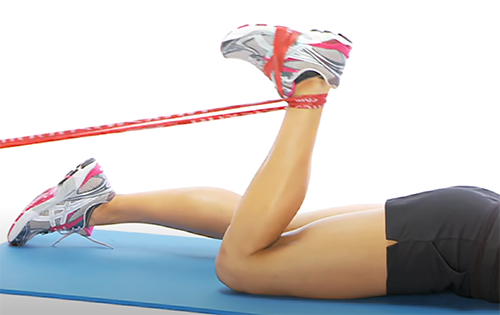
Teaching points:
- Lie on your front and bend your knee against resistance from a band or ankle weights.
- Slowly lower your leg back down under control.
- Keep your hips firmly on the bench and avoid lifting them.
- If your hips lift, reduce the resistance.
- Aim for 3 sets of 10 to 20 repetitions.
- As strength improves, increase resistance and work towards 3 sets of 8 to 10 repetitions to fatigue.
Hip abduction
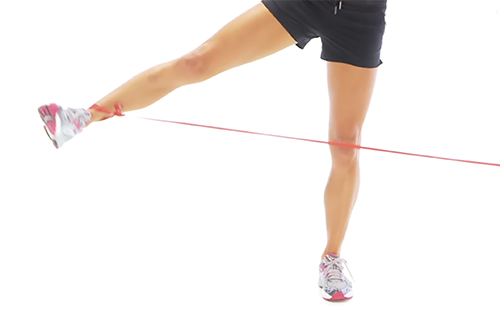
Teaching points:
- Stand on your uninjured leg and move the injured leg out to the side as far as comfortable.
- Slowly return to the starting position under control.
- Hold onto something for balance if needed.
- Use a resistance band or ankle weights to increase difficulty.
- Aim for 3 sets of 10 to 12 repetitions.
Hip extension
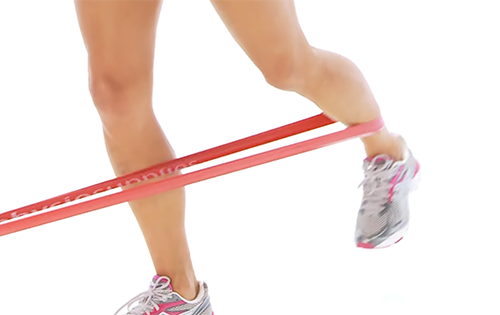
Teaching points:
- Attach a resistance band to your ankle and secure the other end to a fixed point.
- Stand facing the anchor point with the band under slight tension.
- Extend your leg backwards against the resistance.
- Keep your body upright and avoid leaning forward.
- Slowly return to the starting position under control.
Half squat
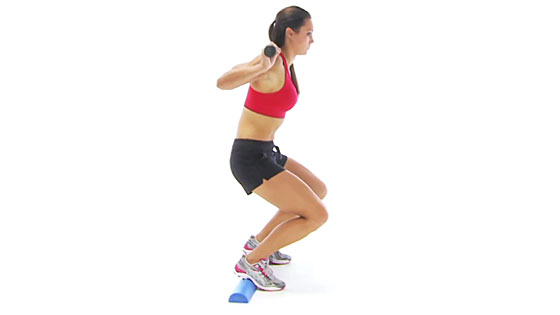
Teaching points:
- Stand with your feet slightly wider than shoulder-width apart, keeping your back straight.
- Lower into a squat to around 45 degrees, or halfway down.
- Keep your knees in line with your toes and avoid letting them collapse inwards.
- Return to the starting position under control.
- Aim for 3 sets of 10 to 20 repetitions.
- Progress by increasing depth, adding weight, or moving to single-leg squats
Lunges
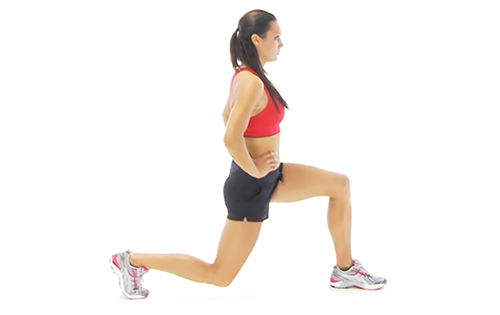
Teaching points:
- Start in a split stance with one foot in front of the other.
- Lower your back knee towards the floor without letting it touch.
- Keep your torso upright throughout the movement.
- Do not let your front knee move past your toes.
- Begin with 2 sets of 10 repetitions on each leg.
- Progress to 3 sets of 15 repetitions as strength improves.
- Add resistance, such as dumbbells or a barbell, to increase difficulty.
Dynamic step back
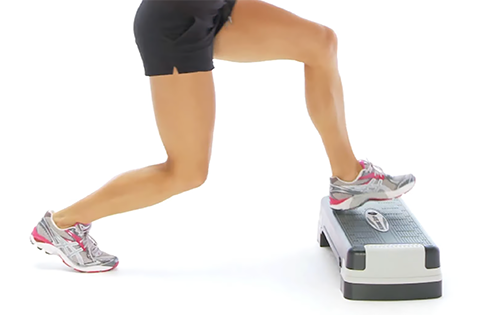
Teaching points:
- Step up onto a stable platform or bench, then step back down under control.
- Keep your knee aligned over your toes and avoid letting it fall inwards.
- Lead with the injured leg where possible.
- Perform 10 repetitions, then switch legs.
- Hold weights to increase difficulty as your strength improves.
Bridge exercises
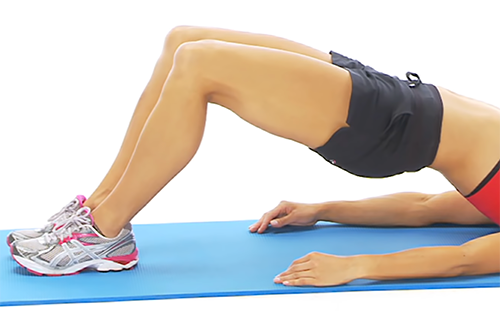
Teaching points:
- Lie on your back with your knees bent and feet flat on the floor.
- Lift your hips upwards to engage the glutes and hamstrings.
- Keep your body in a straight line from shoulders to knees at the top of the movement.
- Hold briefly, then lower back down under control.
- Begin with 3 sets of 8 repetitions and progress to 3 sets of 12.
- Progress to single-leg bridges as strength improves.
Perform single-leg bridges in the same way, keeping your hips level and maintaining a straight line from shoulders to knees. As your strength improves, begin with 3 sets of 8 repetitions and build up gradually.
View our full MCL rehab program for more exercises
MCL sprain proprioception exercises
Proprioception (movement control) exercises help improve balance, coordination, and joint stability after a knee injury. These exercises retrain your body to control the knee properly and reduce the risk of reinjury.
Standing on one leg is a simple way to begin. Progress by closing your eyes or performing the exercise on an unstable surface.
Balance board exercises
Balance boards help improve joint control, coordination, and stability during rehabilitation. They are commonly used for ankle injuries, but are also effective for knee injuries such as MCL sprains.
Using an unstable surface challenges your balance and helps retrain the muscles and ligaments that support the knee.
Functional exercises for MCL sprain
Functional exercises bridge the gap between basic rehabilitation and a return to sport, introducing more dynamic movements that prepare the knee for real-life and sport-specific demands.
Exercises should progress gradually based on your recovery and the demands of your sport. Seek guidance from a physiotherapist or coach to ensure a safe return to activity.
A skipping drill: Linear
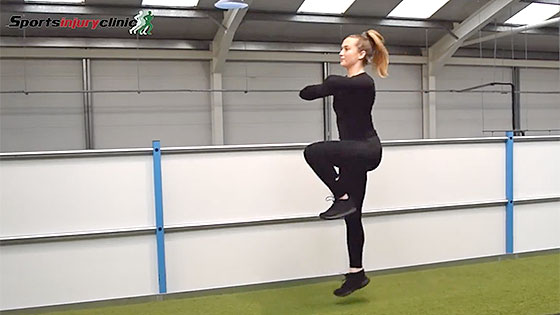
Teaching points:
- Perform the drill in a straight line.
- Progress from marching to a skipping movement to increase intensity.
- Drive the knee up dynamically and push off the ground with control.
- Aim for 2 sets of 10 metres.
Plyometric exercises
Plyometric exercises involve jumping, hopping, and bounding movements to develop power in the muscles. As a result, they are used in the later stages of rehabilitation to prepare the knee for the demands of sport.
Agility drills
Agility drills involve changing direction and reacting to movement, helping to restore speed, control, and confidence in the knee. They are introduced in the later stages of rehabilitation to prepare you for a return to full sport.
Progress gradually. For example, start with short sessions or reduced playing time before returning to full training or competition to reduce the risk of reinjury.
- View our full MCL rehab program for more exercises
References
- Indelicato PA. Isolated medial collateral injuries in the knee. J Am Acad Orthop Surg 1995;3(1):9–14.