Buttock, hip & groin pain are often linked and may be referred from the lower back or surrounding structures. This area is complex, with many muscles, tendons and joints that can cause pain, making diagnosis and treatment more challenging.
Learn more about buttock pain causes and treatment:
Buttock pain
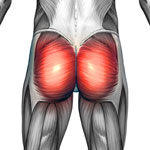
Pain in the buttocks often develops gradually and may be referred from the lower back, hips or thigh. One of the most common causes is Sacroiliac joint pain. The sacroiliac joint sits at the base of the spine and can become inflamed and painful.
Symptoms may include a sharp pain or a dull ache in the lower back that spreads into the buttocks. Sacroiliac joint pain can result from trauma, poor biomechanics, inflammatory conditions or hormonal changes such as pregnancy.
Piriformis syndrome occurs when the sciatic nerve is compressed by the piriformis muscle, causing buttock pain that may radiate down the leg. Injuries affecting the upper hamstring region (just below the buttocks) often produce similar symptoms. Hamstring origin tendinopathy involves degeneration or inflammation of the tendon, while ischiogluteal bursitis is inflammation of the bursa (a small fluid-filled sac) between the tendon and bone. Both conditions typically cause gradual onset buttock pain. In contrast, a hamstring origin strain or avulsion injury usually causes sudden pain beneath the buttocks.
Read more on buttock pain.
Hip pain
Hip pain often develops gradually and can have a number of causes. Labral tears and osteoarthritis are common, particularly in older athletes with a history of high activity.
A labral tear involves damage to the cartilage lining of the hip joint. It often occurs in sports that involve repeated hip abduction (movement out to the side), such as hurdling, breaststroke swimming and horse riding. One common cause is cam impingement, where abnormal bone growth at the neck of the femur pinches the joint lining.
Osteoarthritis of the hip is a degenerative condition involving wear and tear of the joint cartilage. It leads to gradually worsening hip pain, reduced mobility and joint stiffness.
Perthes’ disease affects children, most commonly boys aged between four and ten years old, with symptoms of tiredness, hip and groin pain. Medical help is needed to diagnose this condition as early as possible to try to prevent and limit any future problems.
Read more on Hip pain
Groin pain
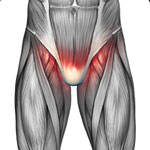
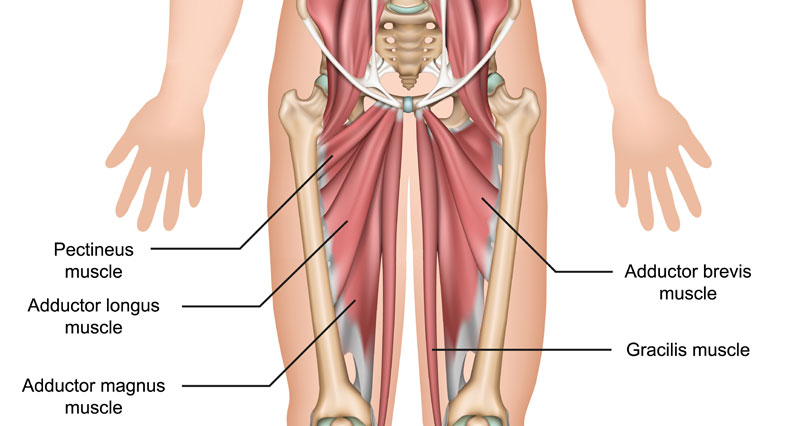
The most common cause of pain in the groin is an acute Groin strain, and this is frequently seen in twisting and turning sports, such as American football, rugby, and soccer. Symptoms include a sudden sharp pain in the groin area, either in the belly of the muscle or higher up where the tendon attaches to the pelvic bone. There is often swelling (oedema) as a result of a groin strain, but this is often not visible to the naked eye. Groin strains are graded 1, 2 or 3 depending on the extent of the injury.
A Hernia occurs when an internal part of the body (such as the intestine), pushes through a weakness in the overlying muscle wall, causing pain which increases with exercise and even when coughing. The two most common types of hernia are ingoinal hernia and femoral hernia. Gilmore’s groin is a complex muscular-tendinous dislocation of the lower abdomen with symptoms of groin pain which increases when running, sprinting, twisting and turning.
Read more on Groin pain.
Hip and groin pain in Children
Hip and groin pain in children should always be assessed by a qualified medical professional as soon as possible. What may appear to be a mild condition can sometimes indicate a more serious problem with long-term consequences.
Several conditions can cause hip and groin pain in children. One of the most common is Perthes’ disease, which typically affects children between the ages of four and eight, although it can also occur in younger children and teenagers.
Parents and guardians should look for signs such as stiffness and reduced range of movement in the hip. Perthes’ disease should be considered if these symptoms are present. In more severe cases, a child may develop a noticeable limp, and the affected leg may appear shorter than the other.
Diagnosing hip and groin pain in children can be challenging. Many different structures in the hip area can cause pain, and younger children often struggle to describe their symptoms clearly. As a result, pain is sometimes dismissed as “growing pains”, but this should not be assumed.
If there is any doubt, seek advice from a medical professional, ideally one specialising in paediatrics. Missed or incorrect diagnoses of hip conditions in children can lead to serious long-term complications.
Severe hip or groin pain in children requires urgent medical attention. Conditions such as muscle strains can produce similar symptoms to more serious injuries like stress fractures. A professional assessment is essential, as stress fractures in children are considered a medical emergency.
When should I see a doctor?
- Severe pain in or around the hip or groin area, especially during walking.
- A “giving way” feeling in the hip during walking or going up/downstairs.
- Altered sensation in the leg – such as a feeling of “pins and needles” (paresthesia) or a “loss of feeling” (anaesthesia).
- Unable to complete your normal daily activities after the initial 72 hours.
Further medical advice can be obtained from your GP or a private clinician such as a physiotherapist, sports therapist, osteopath or chiropractor.
If you have followed the P.R.I.C.E. principles and are still unable to walk after 72 hours, or your pain remains severe and does not improve, attend A&E for further assessment. Seek urgent medical attention if your hip gives way while walking.
If symptoms persist beyond the early stage, seek further advice. Ongoing weakness lasting more than two weeks or continued discomfort indicates the need for specialist assessment. A physiotherapist, sports therapist, osteopath or chiropractor can provide a structured rehabilitation programme and guide your recovery.