Proximal hamstring tendinopathy is a common overuse injury causing pain just below the buttock, at the top of the hamstring. Also known as upper hamstring tendonitis, it typically develops gradually over time and is often worse during running, sprinting, or prolonged sitting.
Medically reviewed by Dr Chaminda Goonetilleke, 10th Feb. 2022.
On this page:
Symptoms
Proximal hamstring tendonitis symptoms are almost identical to Ischiogluteal bursitis and it is often difficult to tell them apart. They include:
- Pain and tenderness at the ischial tuberosity (sitting bones)
- Pain just below the buttock at the top of the thigh Gradual onset of pain (not a sudden injury)
- Pain worse with running, especially sprinting or uphill
- Discomfort when sitting for long periods
- Pain when stretching the hamstring muscles
- Pain when contracting the hamstring muscles against resistance
Diagnosis
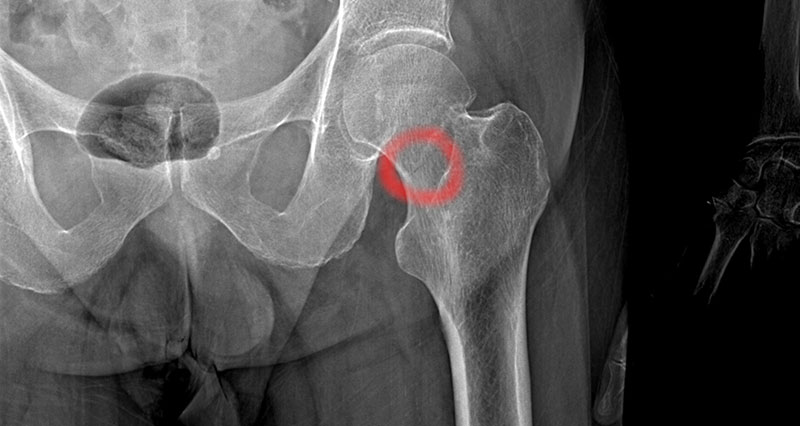
Proximal hamstring tendinopathy is usually diagnosed based on symptoms and physical examination.
A physiotherapist or doctor will assess:
- Localised pain and tenderness at the ischial tuberosity (sit bone)
- Pain when the hamstring is contracted against resistance
- Pain when the hamstring is stretched
- Gradual onset of symptoms linked to running or overuse
In most cases, imaging is not required. However, ultrasound or MRI scans may be used to confirm the diagnosis or rule out other conditions, particularly in long-term or severe cases.
How bad is my Proximal Hamstring Tendinopathy?
Answer based on how your symptoms are right now.
Similar injuries: What else might it be?
Pain just below the buttock is not always caused by proximal hamstring tendinopathy. Other conditions with similar symptoms include:
Ischiogluteal Bursitis
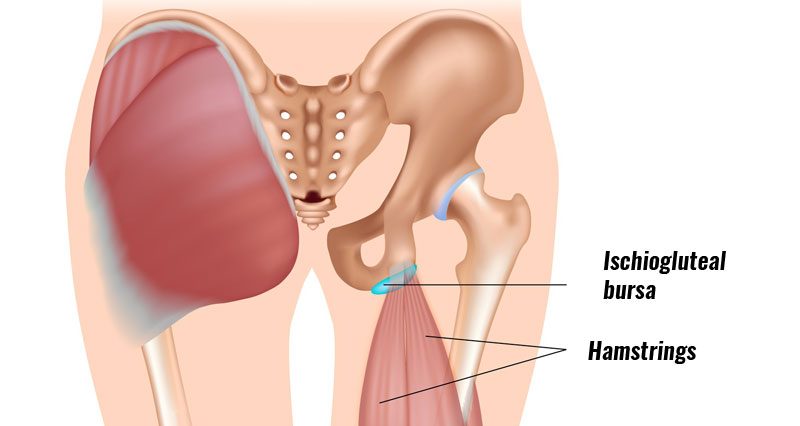
Inflammation of the bursa between the tendon and bone. Pain is typically worse when sitting and may not be as painful during resisted muscle contraction.
Upper hamstring strain
A more acute injury caused by a sudden stretch or forceful contraction. Symptoms usually occur suddenly, often during sprinting or kicking.
Sciatic nerve irritation
The sciatic nerve runs close to the hamstring origin and can become irritated. Pain may radiate down the back of the leg and may be associated with tingling or altered sensation.
Referred pain from the lower back
Pain originating from the lumbar spine can be felt in the buttock or upper hamstring. Often associated with back stiffness or previous back problems.
What is Proximal Hamstring Tendinopathy?
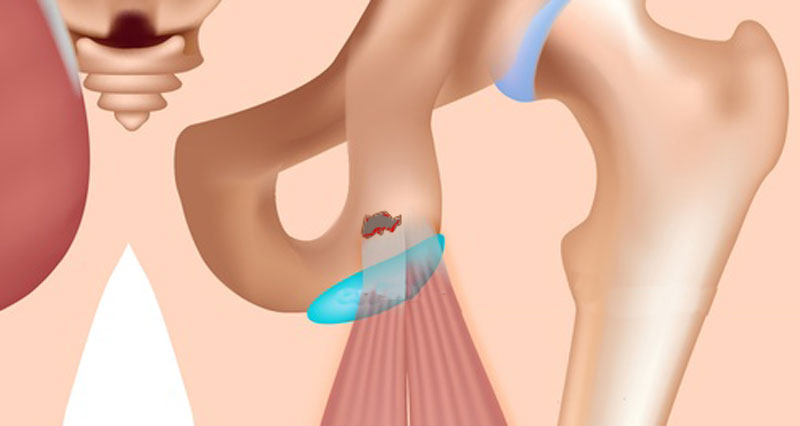
The hamstring muscles attach to the ischial tuberosity at the top of the thigh via a strong tendon. This is the area affected in Proximal Hamstring Tendinopathy.
This condition usually develops due to repetitive loading and overuse, particularly from running, sprinting, or activities involving powerful hip extension. It may also occur following a previous hamstring injury that has not fully healed.
Although often referred to as “tendonitis”, this is usually not a true inflammatory condition. Instead, it is more accurately described as a tendinopathy, where the tendon becomes weakened and degenerates over time due to repeated stress.
Hamstring muscles
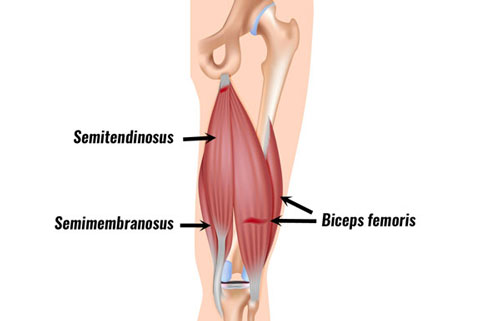
There are three main muscles in the hamstring group:
- Biceps femoris
- Semitendinosus
- Semimembranosus
These muscles work together to bend the knee and extend the hip, playing an important role in running, sprinting, and jumping.
Treatment
Treatment for focuses on reducing load and gradually rebuilding strength. Complete rest alone is rarely effective. Our step-by-step Proximal Hamstring Tendinopathy rehabilitation program takes you from either chronic or acute injury to full fitness.
Active rest
- Avoid sprinting, hills, and explosive movements
- Reduce running volume rather than stopping completely (if pain allows)
- Avoid prolonged sitting, especially on hard surfaces
The aim is to settle symptoms without complete inactivity.
Pain management
- Apply ice or cold therapy after activity
- Use a cushion or softer surface when sitting
- Gentle mobility exercises may help reduce stiffness
Proximal Hamstring Tendinopathy Rehabilitation
Our step-by-step program is designed to treat both acute and long-term Proximal Hamstring Tendonitis. Whether your injury is recent or has persisted for months, we guide you step by step from pain to full fitness. It’s suitable for all levels – from beginners to elite athletes – with each phase tailored to your symptoms and readiness to progress. I comprises the following exercises:
Stretching and mobility –
Activation exercises – these keep the hip muscles toned and firing properly.
Strengthening – Gradually increase the load through the hamstrings. Isometric exercises early on progressing to more dynamic hamstring specific exercises later.
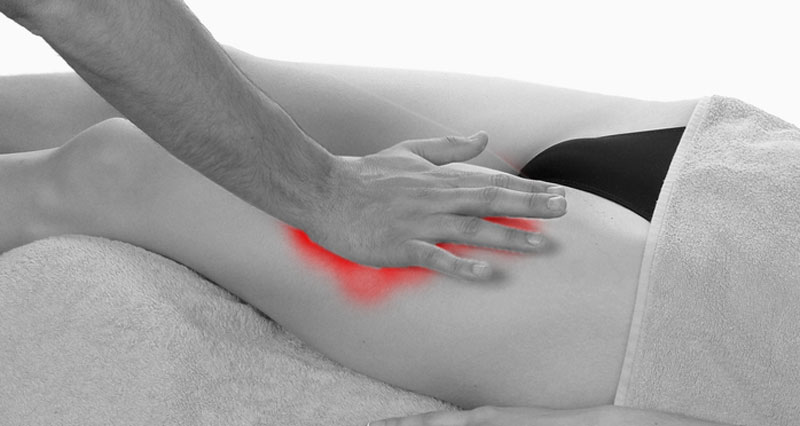
Sports massage – may help in some cases. Both cross frictions to the tendon itself, and deep tissue techniques to the muscle. The latter helps reduce muscle tightness. However, if symptoms worsen, consider Ischiogluteal Bursitis, as massage may aggravate it.
Conditioning – to maintain aerobic fitness. Stationary cycling or swimming early on, later return to running gradually.
What can a doctor or physio do?
A doctor or physiotherapist may recommend:
- NSAIDs for short-term pain relief
- Shockwave therapy for chronic cases
- Corticosteroid injections (short-term relief only, not a long-term solution)
Occasionally fibrous adhesions may develop on the tendon in chronic cases. These fibrous adhesions can irritate the sciatic nerve as it passes above the Ischial tuberosity and then down past the biceps femoris muscle. These adhesions may not respond to deep friction massage and stretching. This condition is known as hamstring syndrome and may require surgery.
Returning to sport
- Gradual return to running
- Start with low intensity, flat surfaces
- Avoid sprinting until pain-free strength is restored
Returning too soon is a common cause of recurrence.
References & further reading
- Google Scholar – Ischiogluteal bursitis
Sports Injuries > Thigh > Back Thigh >