Neural flossing exercises, also known as nerve glides or neural mobilization, help improve nerve mobility and reduce sensitivity. This variation targets the sciatic nerve, helping it move more freely through surrounding tissues.
This exercise is often used when nerve tension contributes to symptoms in the lower limb.
This exercise is included in our plantar fasciitis rehabilitation program, where it is used to improve nerve mobility and reduce tension through the lower limb.
How to perform neural flossing exercises
- Lie on your back with one leg lifted
- Hold behind your thigh to support the leg
- Slowly straighten your knee until you feel gentle tension
- At the same time, lift your head slightly
- Then bend your knee as you lower your head back down
- Continue this controlled “on/off” movement
- Keep the movement smooth and do not force the stretch
Key points
- Movement should be gentle, not aggressive
- You should feel tension, not pain
- Do not hold the stretch — keep it moving
- Stay relaxed throughout
- Stop if symptoms worsen
What are neural flossing exercises?
Neural flossing exercises involve moving a nerve back and forth through its surrounding tissues. Unlike static stretching, these exercises aim to reduce nerve sensitivity and improve mobility without placing excessive strain on the nerve.
They are commonly used to help manage nerve-related symptoms and improve overall movement in the lower limb.
Areas targeted
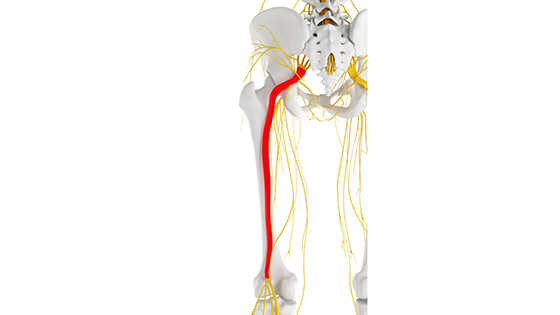
This exercise primarily mobilizes the sciatic nerve, which runs from the lower back through the buttock and down the leg. You may feel a gentle pulling sensation along this pathway.
The sciatic nerve
The sciatic nerve is the largest in the body. It runs from the lower back through the hips and down the legs, providing both movement and sensation. When irritated, it can contribute to tightness, discomfort or altered movement patterns in the lower limb.
Related injuries
This exercise forms part of rehabilitation for the following injuries: