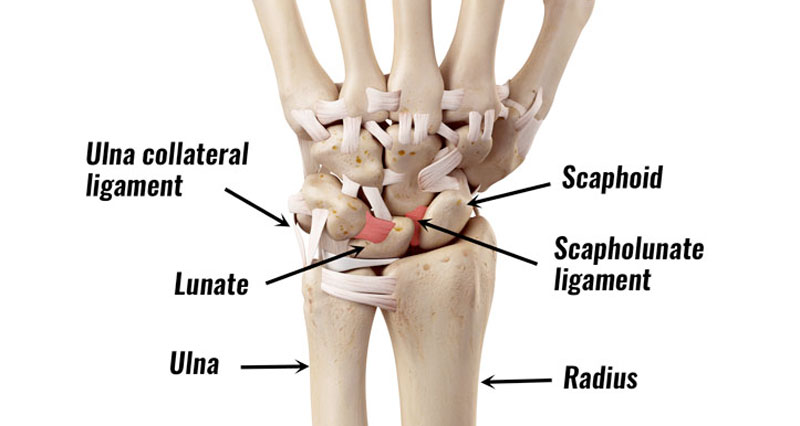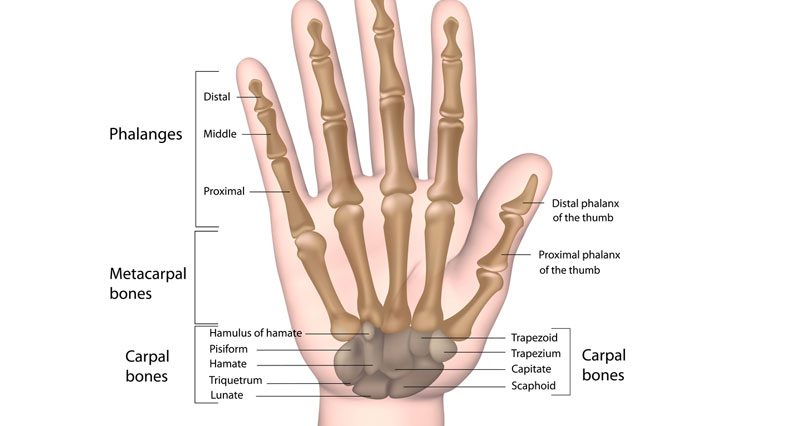
The metacarpal bones are the five long bones in the hand. Any of these bones can be broken or fractured. The the 1st metacarpal under the base of the thumb is the most commonly injured. Here we explain the different hand fractures and how they are treated.
On this page:
Go direct to:
Broken hand symptoms
Symptoms will depend on which type of fracture you have. In general broken hand symptoms include:
- Sudden, severe pain in the hand. Common specific locations are at the base of the thumb and on the outside (little finger side) of the hand.
- Trying to move your hand will be painful.
- Swelling will usually develop rapidly.
- Later, bruising my develop. This results from any internal bleeding which pools under the skin.
- In a severe fracture you hand will appear deformed. This is known as a displaced fracture. An open fracture is where bone has pierced though the skin.
Types of metacarpal fracture
The metacarpals, particularly the base of the first metacarpal are usually fractured as a result of impact or sudden trauma such as punching, or a fall onto the hand if your thumb is extended out to the side. There are three main types of metacarpal fracture:
- A transverse (horizontal) fracture to the first metacarpal (thumb), just above the joint.
- A fracture at the base of the joint, called a Bennett fracture, or Rolando fracture.
Any of the metacarpal bones in the hand can fracture. Another commin broken hand injury is a Boxer’s fracture to the outside of the hand.
Boxer’s fracture
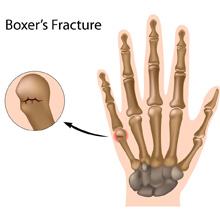
A Boxer’s fracture is a break to either the 4th or the 5th Metacarpals. It is usually caused by a hard impact, for example punching a wall or similar.
The outside edge of your hand will be particularly tender and the knuckle might appear dropped.
Read more on Boxer’s fracture.
Bennett fracture
A Bennett’s fracture-dislocation of the joint between the metacarpal and the carpal bones of the wrist is a specific and more serious injury requiring surgical treatment from a specialist wrist and hand surgeon.
Read more on Bennett’s fracture.
Rolando fracture
A Rolando Fracture is a fracture to the base of the thumb, similar to a Bennett fracture, although more complex to treat. It is usually caused by a sudden impact or trauma, such as punching something hard.
Read more on Rolando fractures.
Treatment of metacarpal fractures
If you suspect a broken hand, seek medical attention as soon as possible. Treatment will depend on your specific injury, how bad it is and whether there is any associated soft tissue damage.
- Most metacarpal fractures which are straightforward without other complications. They are treated with immobilization in a plaster cast or splint for a period of 2-6 weeks. Of course this depends on the type of fracture.
- More complex fractures or those with a displacement of the bones may require surgery. A Rolando fracture will require surgery to reduce (put back into place) the fragments of fractured bone.
Rehabilitation exercises for a broken hand
Rehabilitation of metacarpal fractures involves regaining full mobility and strength, in particular of the intrinsic muscles of the hand. Items such as hand putty and therapy balls can be great for doing this.
Go to wrist & hand exercises.
References & further reading
- Paulius K, Maguina P, Mejia A. Ultrasound-guided management of hand fractures. Orthopedics 2008;31(12).