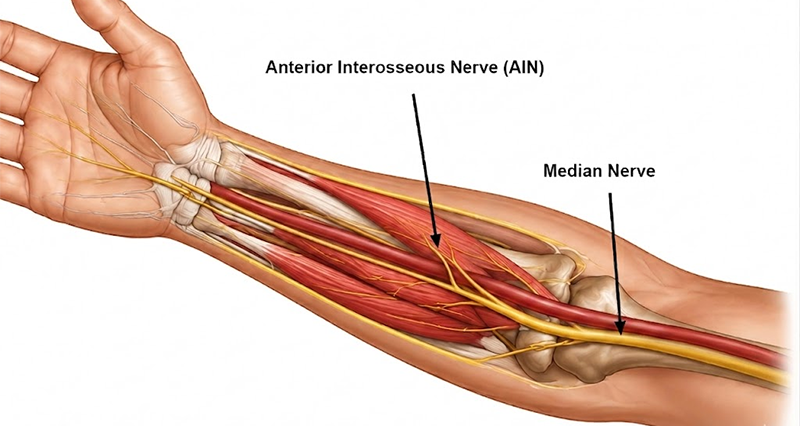
Anterior interosseous nerve syndrome (AINS) occurs when a branch of the median nerve becomes compressed or inflamed in the forearm. The condition causes weakness in the thumb, index finger and sometimes the middle finger, affecting pinch grip and fine finger movements. Unlike many nerve injuries, AINS usually does not cause numbness or tingling because the nerve only supplies muscles, not skin sensation.
Symptoms of anterior interosseous nerve syndrome
Symptoms usually develop gradually, although they can occur suddenly after trauma or overuse.
Common symptoms include:
- Weakness when pinching with the thumb and index finger
- Difficulty gripping small objects
- Trouble making an “OK” sign
- Weakness bending the tip of the thumb or index finger
- Pain in the front of the forearm, sometimes radiating towards the elbow
- Reduced hand coordination and fine finger control
In more severe cases, the middle finger may also become weak.
Pinch test
A simple test for AINS is the “OK sign” or pinch grip test which helps identify weakness in the muscles supplied by the anterior interosseous nerve.
If you pinch your thumb and index finger together, they normally form a round “O” shape. However, with anterior interosseous nerve syndrome, weakness in the muscles controlling the thumb and index finger means the tip joints do not bend properly, creating a flattened pinch shape instead.
Normally, touching the thumb and index finger together forms a round circle. With anterior interosseous nerve syndrome, weakness in the muscles causes the thumb and index finger to stay straighter, creating a flattened pinch shape instead.
What causes anterior interosseous nerve syndrome?
The anterior interosseous nerve can become compressed or irritated as it passes through the forearm.
Common causes include:
Muscle compression
Tight or enlarged muscles in the forearm may compress the nerve, particularly the pronator teres muscle or deep forearm flexor muscles.
Trauma and fractures
Injuries around the elbow or forearm can damage or compress the nerve, including:
- Supracondylar fractures of the humerus
- Forearm fractures
- Elbow dislocations
- Direct blows to the forearm
Inflammation
Inflamed tissues or enlarged bursae around the elbow may place pressure on the nerve.
Neuritis
In some cases, AINS develops due to inflammation of the nerve itself rather than true mechanical compression. This may occur as part of neuralgic amyotrophy (Parsonage-Turner syndrome).
Thrombosis
In rare cases, thrombosis of the radial or ulnar artery may compress the anterior interosseous nerve.
Anatomy
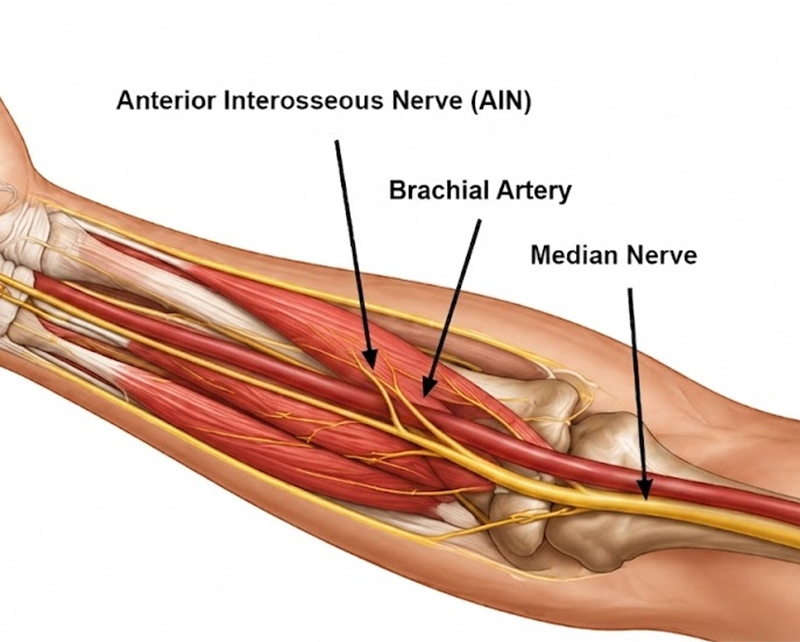
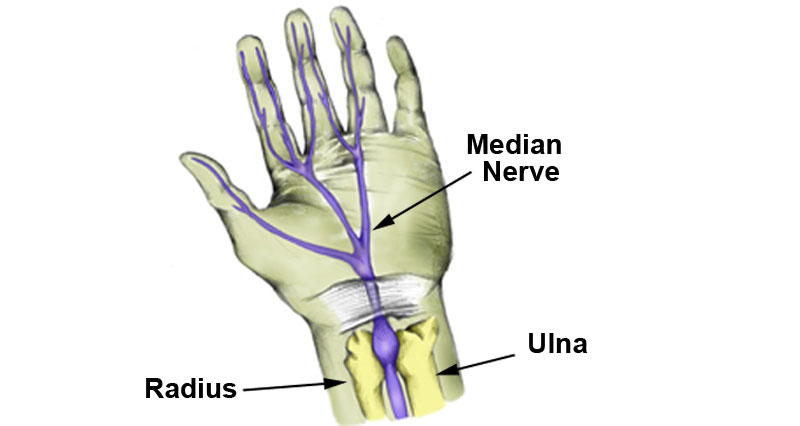
The anterior interosseous nerve branches from the median nerve just below the elbow and travels down the front of the forearm.
It supplies three important muscles:
- Flexor pollicis longus (thumb flexion)
- Flexor digitorum profundus to the index and middle fingers
- Pronator quadratus (forearm pronation)
Weakness in these muscles causes the characteristic pinch grip problems seen with AINS.
Treatment for anterior interosseous nerve syndrome
Treatment usually begins with conservative management (without surgery).
Rest and activity modification
Avoid activities that aggravate your symptoms, especially repetitive gripping or forearm twisting movements.
Splinting
Wear a wrist splint to help rest the forearm and reduce irritation of the nerve.
Medication
Anti-inflammatory medication may help reduce pain and inflammation. Always check with your doctor or pharmacist before taking medication.
Physiotherapy
Rehabilitation may include:
- Gentle stretching exercises
- Nerve gliding exercises
- Soft tissue treatment
- Strengthening exercises as symptoms improve
Corticosteroid injections
In some cases, corticosteroid injections may help reduce inflammation around the nerve.
Surgery
If symptoms fail to improve after several months, surgery may be considered to release pressure on the nerve. Most people recover well, although recovery can sometimes take several months.