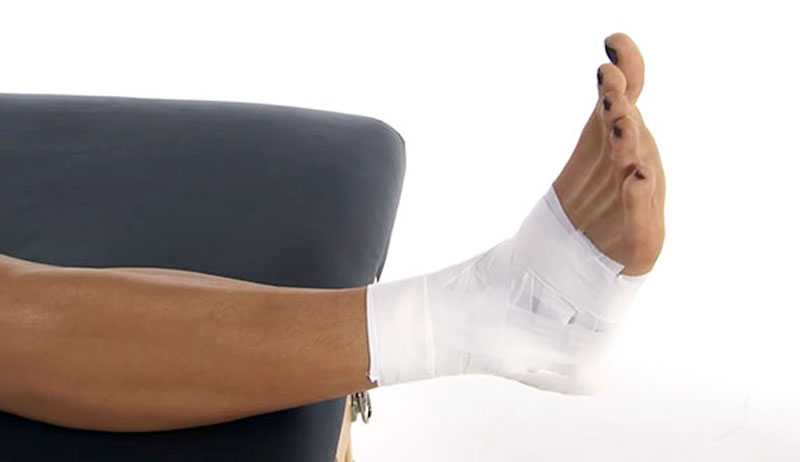
Ankle sprain exercises are essential to restore movement, strength and stability after injury. The right exercises help reduce pain, improve balance and prevent the ankle from becoming weak or unstable.
However, starting too early or choosing the wrong exercises can delay recovery or increase the risk of re-injury. It is important to progress gradually from simple mobility work through to strengthening and functional exercises.
Below, we outline the key exercises used at each stage of ankle sprain rehabilitation.
Exercises should progress in stages, starting with mobility, then strengthening, followed by balance and functional movements.
When can I begin sprained ankle exercises?
You can begin some exercises a day or so after the injury, depending on how bad your sprain is. However, wait until the initial acute phase has passed before trying to really make progress. Exercises should always be pain-free. If it hurts, don’t do it is the general rule here.
Sprained ankle mobility and stretching exercises
If you have sprained your ankle, then you need to be careful about sideways or lateral movements. This is because you may stress and re-injure your sprained ligament.
Active ankle mobility

This exercise maintains ankle mobility without placing stress on the injured ligaments. It also promotes circulation through the calf muscles, helping to reduce swelling.
Pull the foot up as far as it will go (dorsiflexion). Hold for a couple of seconds and then point it away from you (plantar flexion) and hold, then repeat. Avoid sideways (lateral) movements that may stress the injured ligament.
Seated wobble board
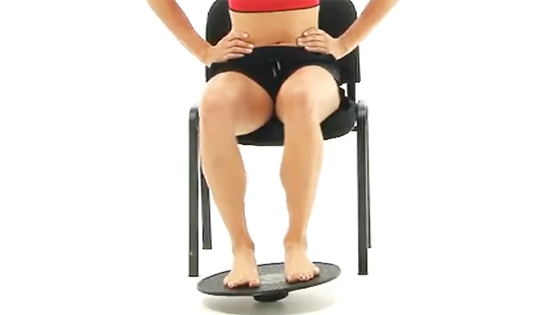
Whilst sitting down, place the wobble board under the feet and slowly rotate it a number of times in each direction. This is a gentle way of improving ankle range of motion and control post-injury.
Balance board-type exercises are best performed on bare feet and on a soft floor such as a carpet (not deep-pile!) or a rug or mat, rather than a hard floor such as wood, as the board is liable to slip.
Sustained calf stretch
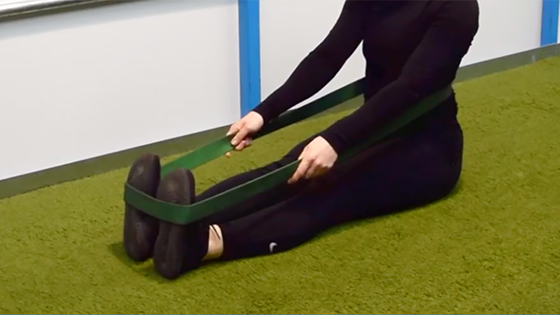
Wrap a resistance band around both feet. Hold the other end of the band and pull your feet towards you. Hold this position for 2 minutes.
Sprained ankle strengthening exercises
These exercises are designed to strengthen the ankle joint after a sprain. During the early stages of rehabilitation, the focus is on isometric or static strengthening exercises that avoid sideways or lateral movements to protect the injured ligament. As recovery progresses, the exercises incorporate movement to further strengthen the ankle.
Isometric strengthening
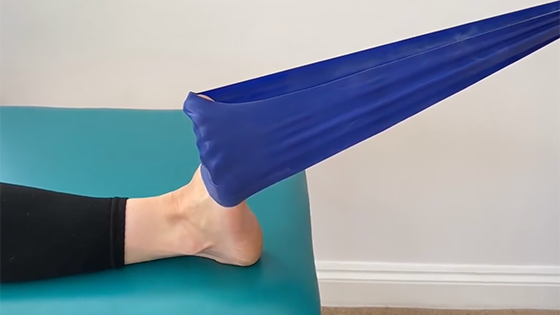
These ankle sprain exercises work the joint in all directions statically. This means without movement. Isometric ankle sprain exercises often form part of the early stages of rehabilitation, as long as pain allows. The aim is to contract your muscles using the band as resistance to prevent movement. Make sure to include inversion, eversion, plantar flexion, and dorsiflexion.
Isometric partner exercises
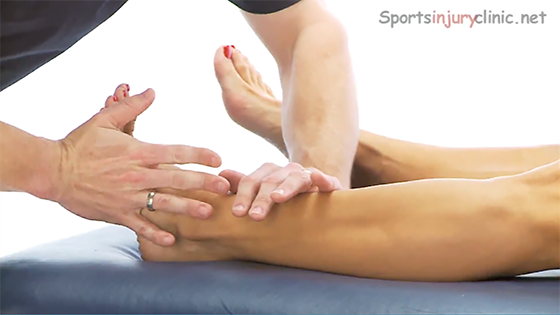
This exercise is best performed with a therapist or partner providing resistance. But you can use any immovable object, for example, a table leg.
To strengthen the inverters (tibialis posterior muscle), push the inside of the foot against a table or chair leg. Try to turn the foot inwards against resistance. To strengthen the evertors (peroneal muscles), push the outside of your foot against a table or chair leg. Try to turn the foot outwards.
Slow ankle inversion
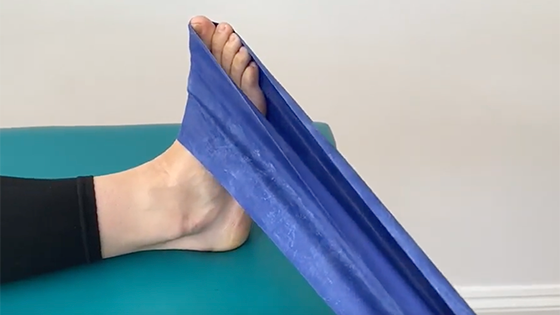
Wrap a resistance band around the forefoot and anchor it to a table leg, or get a partner to hold it. This exercise works the ankle inverter muscles as you turn your foot slowly inwards against the resistance of the band. Aim for 6-second reps.
Slow ankle eversion

Ankle eversion is the movement of turning the sole of the foot outwards, away from the other foot.
Bent knee calf stretch
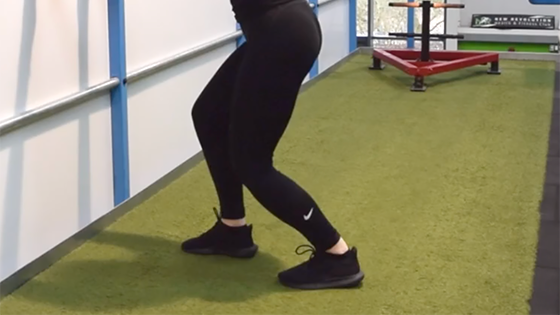
Bent knee calf stretch targets the deeper Soleus muscle at the back of your lower leg.
Stand with the leg you want to stretch at the back. Bend your knee and ease into feel a stretch lower down at the back of your leg.
Straight leg calf stretch
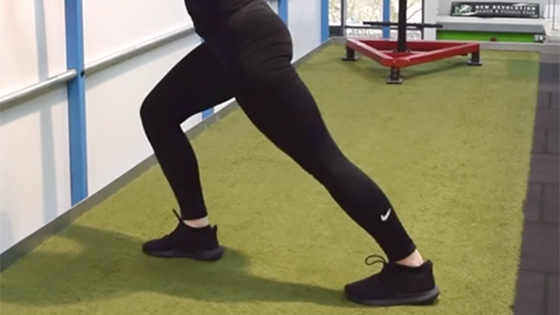
Stretch with your back knee straight to target the larger Gastrocnemius muscle. Both are important for treating Plantar fasciitis.
Step down counterbalance front
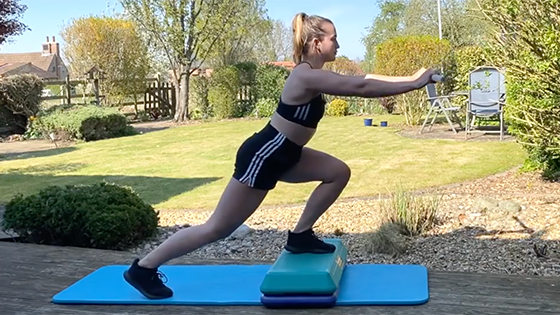
Start by holding a stick or pole directly in front of you at chest height. Use the pole as a counterbalance as you step down. Execute the movement slowly and with control. Complete 3 to 4 sets, performing 6 to 8 repetitions with each leg.
Step down counterbalance squat side
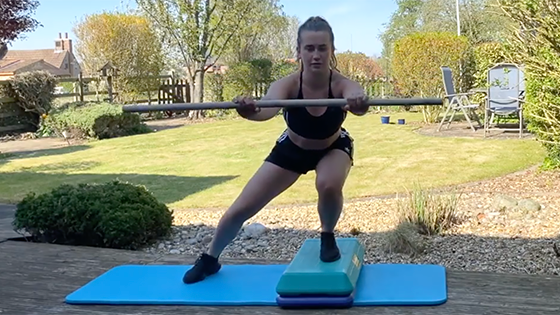
Using a long pole to aid balance, step down slowly to the side. Keep the movement slow and controlled all the way down, then return to the starting position.
Heel raise in lunge
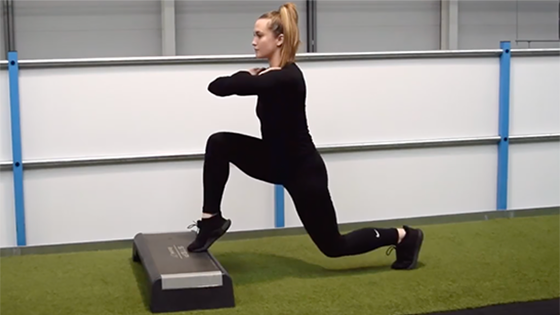
Go into a lunge position with your foot either flat on the floor or slightly raised on a step or block. Keep in the lunge position as you perform heel raise exercises at the ankle.
Movement control ankle sprain exercises
These are important sprained ankle exercises. They improve proprioception, which is your body’s ability to sense where parts of it are in space. This is damaged when you sprain your ankle. As a result, you are more susceptible to recurrent sprains if you fail to do movement control exercises for ankle sprains.
Standing wobble board
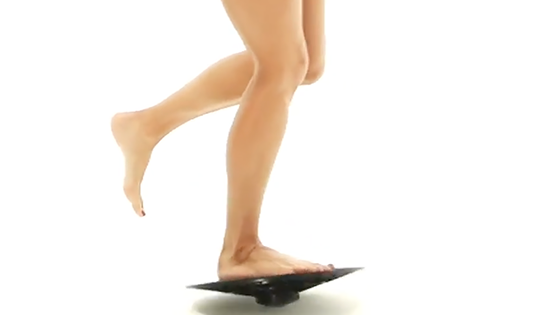
Stand on the wobble board with one leg. Rock the board from front to back and then side to side (30 seconds each). Rotate the board in a circular motion in one direction for 30 seconds, then repeat in the other direction. Perform this with both legs for easy and single leg to make it harder.
Single-leg balance
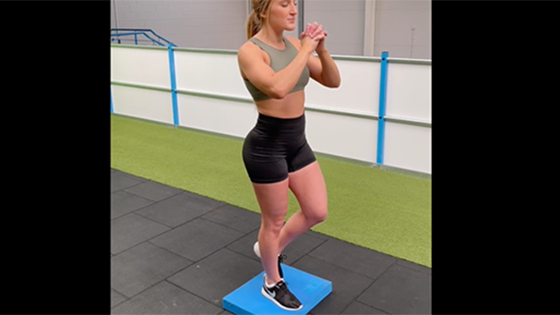
Begin by standing on the injured leg for just 30 seconds. Once this is easy, close your eyes to increase the difficulty.
Forward T
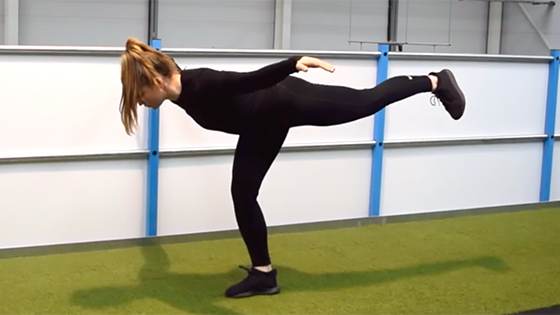
Stand on one leg with your knee slightly bent. Lean forward, open up your arms, pulling the non-supporting leg backwards to make the shape of a ‘T’. Maintain balance for 4 or 5 seconds and repeat.
Forward T to Spiderman
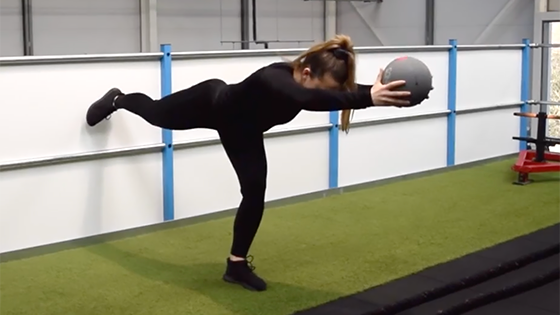
Stand on one leg and lean forward into the ‘Forward T’ position. Maintain this balance for a few seconds, then return to an upright stance. Next, keeping your foot off the floor, extend your leg sideways into the ‘Spiderman’ position and hold it. Ensure you control your movements throughout. Perform two sets of six repetitions for each leg.
Lunge lean hold
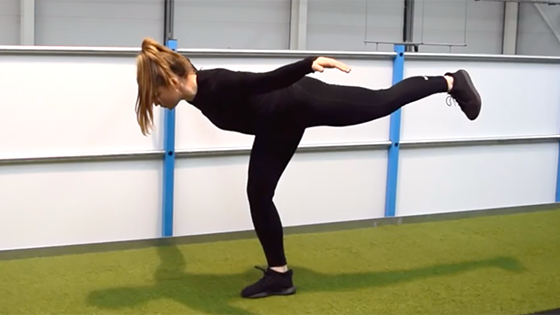
Lunge onto the forward leg and get your balance. Then lean forward over the supporting leg, lifting the back leg up into the ‘T’ position. Hold for 5 seconds, then bring the back leg through, knee up in front to finish.
Functional sprained ankle exercises
These exercises prepare your ankle for returning to normal activity, including walking, running and sport-specific movements.
A lock at wall
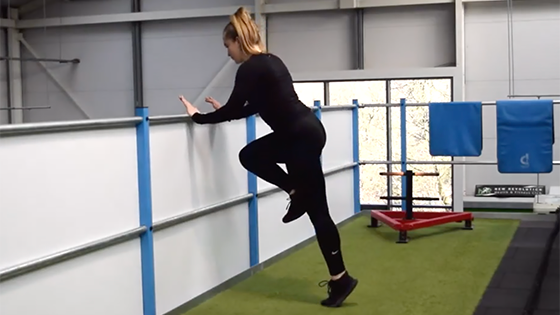
Leaning tower exercise, also known as an ‘A’ lock, is performed against a wall. Drive the knee upwards and hold the position.
A march linear
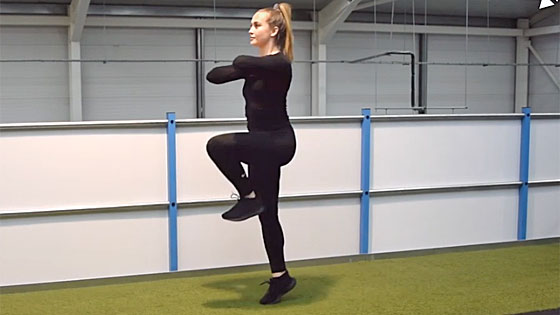
March forward with a high knee lift and a firm foot placement on the floor. Either flat-footed or if your ankles are feeling good, you can go up onto your toes.
A march lateral
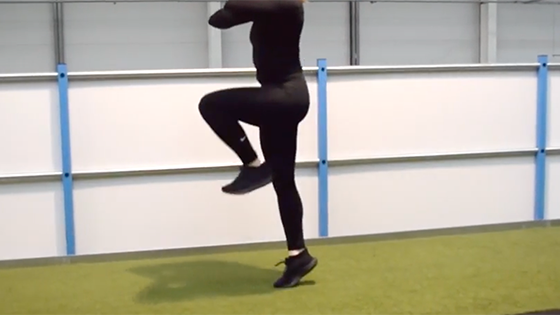
March sideways with a high knee lift and a firm foot placement on the floor. Either flat-footed or if your ankles are feeling good, you can go up onto your toes.
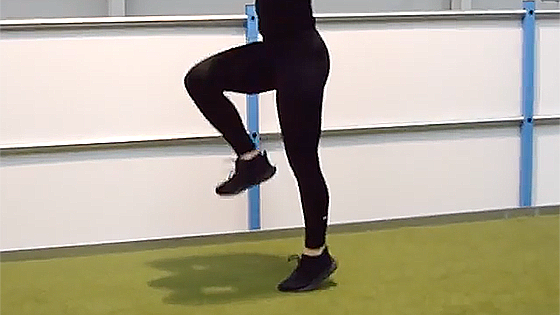
Heel-toe walk
Start with a heel strike and once you get to the forefoot push-off, come up onto the toes. Swing the other leg forward and heel strike with the next foot to continue. Make sure you do this slowly and under complete control.
Activation ankle sprain exercises
Although not specifically for strengthening the ankles, these form an important part of our Ankle sprain rehab program. They keep the hip muscles firing and working well.
Crab walk
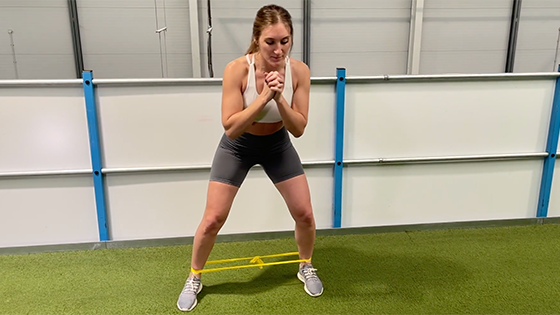
Place a resistance band around your knees and walk sideways. Keep good athletic posture and stance. This gets the hip muscles firing and fatiguing under bodyweight load.
Ice skaters
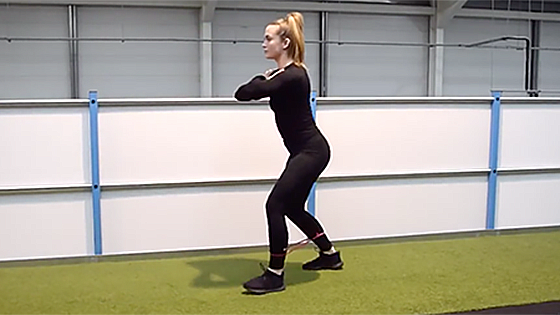
Place a resistance band around your knees to increase the load on your lateral hip muscles. Walk forward and backwards. Maintain a good posture by keeping your head and chest up.
Download our app to follow a structured, step-by-step ankle sprain rehabilitation programme with guided exercises, progress tracking and clear progression through each stage of recovery.
Program author: Phil Pask
Phil is one of the World’s most experienced Sports Physiotherapists. He has been the England Senior Rugby Team’s Physiotherapist since 1997, continuing his role in recent years as a Consultant Physio to the team. He was a player, physio, and head of performance at Northampton Saints from 1986 to 2002.