Piriformis Syndrome Exercises
Piriformis syndrome exercises aim to reduce tension in the piriformis muscle, relieve pressure on the sciatic nerve and ease pain. Any piriformis syndrome rehabilitation program should include gentle stretching, strengthening and soft tissue release exercises.
On this page:
Piriformis syndrome stretching exercises
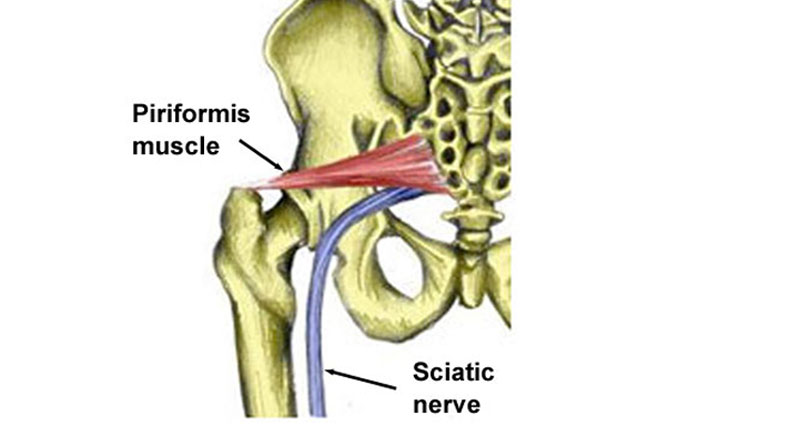
The piriformis muscle is deep within the buttock. Stretch daily, and in the early stages 3 times per day or more may be beneficial. We also include stretching exercises for the groin and other hip muscles to balance the joint.
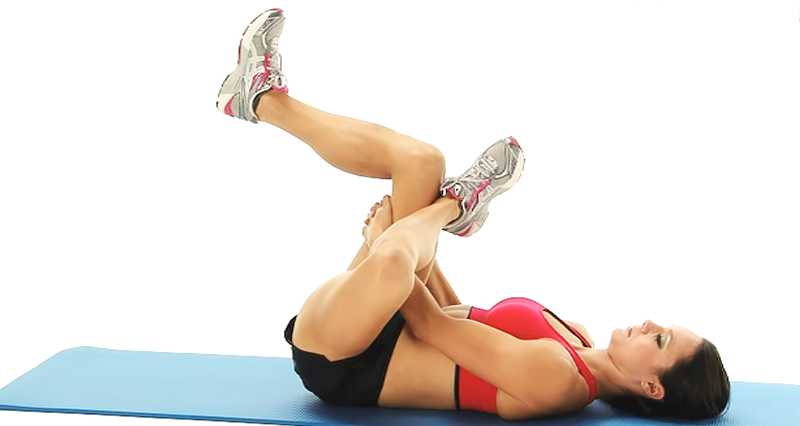
Piriformis stretch
Here we include 3 exercises to stretch the piriformis. Do all three, or just the ones you prefer. Hold the stretches for 30 seconds, repeat 3-5 times, and stretch 3 times a day.
- Lay on your back, pull one knee up and across until you feel a stretch deep in the buttock.
- Lay on your back, pull one leg up so your ankle rests on the thigh of your opposite leg. Grip behind the thigh and pull up until you feel the stretch.
- On your front, tuck your thigh under your chest and use your bodyweight to increase the stretch.
ADVERT
Outer hip stretch
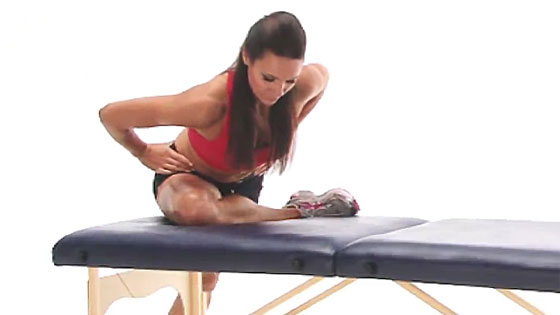
Another version of this stretch is standing up where the knee is placed under and across the body resting on a table. Lean forward using your bodyweight to increase the stretch.
Long adductor stretch
It is important to stretch the long adductor muscles which attach, to the knee as well as the short adductor muscles which attach above the knee. Stretch the long adductor muscles with your leg straight. Short adductor muscles are stretched with the knees bent.
Short adductor muscle stretch
Sit on the floor and put the soles of your feet together. Use your elbows to apply gentle downward pressure to your knees to increase the stretch. You should feel a stretch on the inside of the thigh. Hold this position for 30 seconds, repeat 3-5 times, and stretch 3 times a day.
ADVERT
PNF/Muscle energy technique
A muscle energy technique (MET) is a manual therapy that uses gentle, controlled muscle contractions against resistance to reduce muscle tightness and improve joint mobility.
- With a partner lie on your front and get the partner to rotate the bent leg outwards (towards the horizontal) as far as it will comfortably go.
- Then the athlete applies gentle pressure at about 25% effort to try and return the leg to the vertical.
- The partner resists this movement.
- Hold this pressure for about 10 seconds and then relax. The partner then moves the leg further to stretch the muscle and holds this position for 30 seconds.
- Repeat this process until you get no further improvements in mobility.
- This is an excellent stretching method and has produced some exceptional and instantaneous results. This should only be done by trained therapists.
Foam roller exercises for piriformis syndrome
Use a foam roller to apply deep tissue myofascial release to the muscle. Cross one leg over the other to place the muscle on stretch, then slowly roll backwards and forwards along its length in a controlled manner.
You may feel mild discomfort, but stop if you experience pain. If you cannot keep the muscle relaxed, reduce the pressure until you can. The goal is to relax the muscle. If pain causes it to tighten, the technique becomes less effective.
ADVERT
Piriformis syndrome strengthening exercises
Strengthening exercises for the piriformis and other hip muscles improve hip stability and reduce strain on the piriformis itself. This helps relieve symptoms and reduces the risk of the condition returning.
Resisted external hip rotation
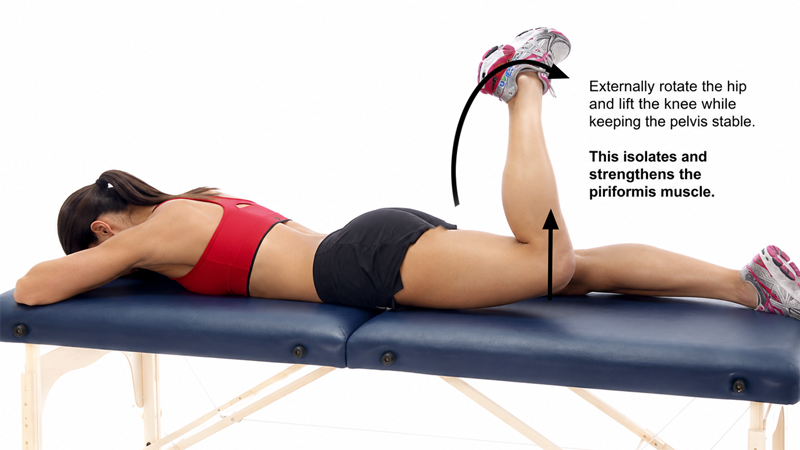
This is the best exercise to work the piriformis muscle specifically. Lie on your front with your knee bent to 90°. Keeping your pelvis still, rotate your hip by moving your foot inwards while lifting your knee slightly off the floor. Slowly return to the starting position and repeat.
Resistance band abduction
- Stand with one end of the band tied around the ankle and the other end attached to a fixed object, close to the floor.
- Move the leg out to the side, away from the body, keeping the knee straight.
- Once you get as far as is comfortable, slowly return the leg back to the centre.
- Repeat 15 times and gradually build this up to 2 sets of 20 reps.
Side-lying clam exercise
- Lay on your side with the hip to be worked on top.
- Bend your knees and position them forwards so that your feet are in line with your spine.
- Make sure your top hip is directly on top of the other and your back is straight.
- Keeping the ankles together, raise the top knee away from the bottom one.
Remember, don’t move your back or tilt your pelvis, all the movement should be coming from the hip. Slowly return it to the starting position. Repeat 15 times initially and gradually build this up to 2 sets of 20.
Hip extension piriformis exercise
- Position yourself on all fours.
- Shift your weight slightly off the leg to be worked.
- Keeping the knee bent, raise the knee off the floor so that the sole of the foot moves towards the ceiling.
- Slowly lower the leg, almost back to the starting position, and repeat.
- Repeat 15 times initially and gradually build this up to 2 sets of 20.