Medically reviewed by Dr Chaminda Goonetilleke, 14th Dec. 2021
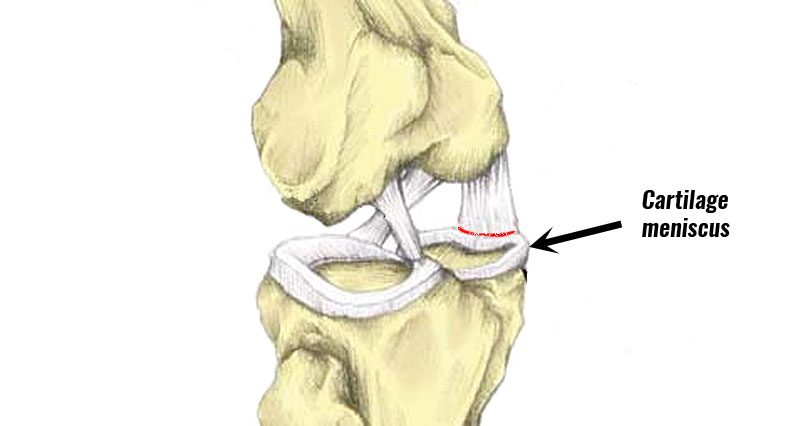
A torn meniscus is a tear of one of the semi-circular cartilage discs in the knee joint. A medial meniscus tear on the inside of the knee is more common. It is caused by direct impact in contact sports or twisting. However, it may also occur in older athletes through gradual degeneration.
Torn meniscus symptoms
Symptoms are usually sudden onset, however, can develop gradually over time. They include:
- Pain on the inside of the knee (medial meniscus) or outside of the knee (lateral meniscus).
- Pain fully bending the knee or squatting.
- Swelling (not always).
- Knee locking or giving way.
- Tenderness pressing in along the joint line on the inside of the knee (for medial).

Diagnosis
Your doctor or physio performs specific assessment tests. These include McMurray’s test and Apley’s test.
They may also refer you for an MRI scan.
McMurray’s test
McMurray’s test is often used to indicate cartilage injuries. With the patient laying on their back the therapist holds the knee with the upper hand and the heel with the lower hand.
To test the medial meniscus they apply a valgus (inward) stress to the knee whilst the other hand rotates the leg externally (outwards) and extends the knee. Pain and/or an audible click while performing this manoeuvre can indicate a torn medial meniscus.
The lateral meniscus is tested by internally rotating the leg and foot. Again, pain and clicking will indicate a positive result.
Apley’s test
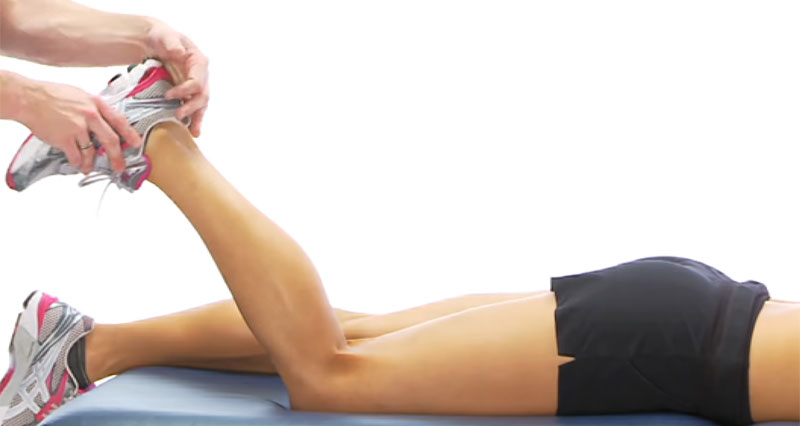
Apley’s test also helps diagnose meniscal tears. The patient is positioned on their front with the knee bent. The therapist applies a downward compressive force through the lower leg at the same time as rotating it.
Apley’s test is positive if it reproduces symptoms, suggesting a torn meniscus.
What is a torn meniscus?
The most common cause of cartilage meniscus injury is twisting the knee with the foot planted to the ground either with or without contact from another player.
A cartilage injury often occurs in conjunction with injury to other structures in the knee such as an anterior cruciate ligament injury or a medial collateral ligament sprain. They can also come on gradually over time through degeneration, especially in an older patient.
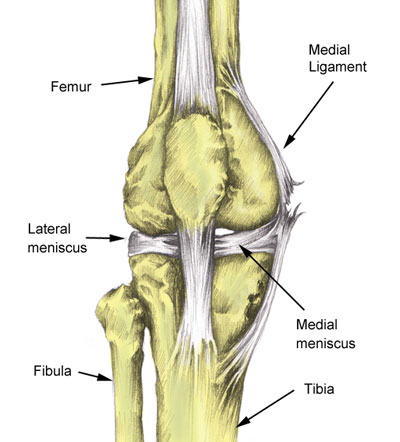
Each knee joint has two crescent-shaped cartilage menisci. These lie on the inside and outside of the upper surface of the tibia or shin bone and act as shock absorbers for the knee. Twisting and compression of the cartilage can cause it to tear.
Types of meniscus tear
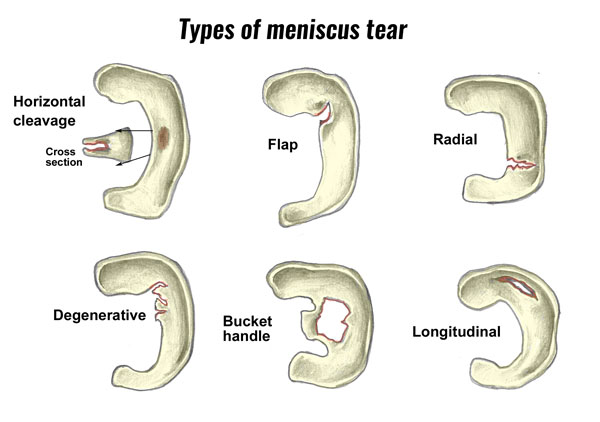
There are different ways in which the cartilage can tear including longitudinal, bucket handle tears, radial tear, and degenerative.
Treatment for a torn meniscus
Immediate first aid after any knee joint injury is to apply the PRICE principles of protection, rest, ice, compression, and elevation.
Cold therapy
Apply ice or cold therapy for 10 minutes every hour initially to reduce pain, swelling, and inflammation. Reduce frequency as your symptoms improve.
Do not apply ice directly to the skin as it may burn. Wrap the ice in a wet tea towel or better still use a specialist cold compression wrap.
Rest
Rest is important to allow the injured tissues to heal. This is often overlooked but is essential for the injury to heal.
Taping & supports
Protect the joint from further injury by taping/strapping the knee joint, or wearing a knee support that has additional support at the sides.
A stabilized knee brace has flexible springs on the sides for additional support or for more severe injuries a hinged knee brace with solid metal supports linked by a hinge will help protect the joint from sideways or lateral movement.
Compression also helps reduce swelling.
Expert interview
Sports Physiotherapist Neal Reynolds explains knee cartilage injuries and treatment options.
Medial meniscus tear surgery
The decision of whether to operate will depend on a number of factors.
A minor tear or small degenerative condition with no restriction of motion or locking is treated conservatively. This means without surgery. More severe injuries may require surgical treatment.
Orthopaedic Surgeon Mr. Richard Villar explains meniscus tear surgery, surgical techniques, and recovery times.
An MRI scan confirms the diagnosis. Then an arthroscopy is performed to either repair or remove the torn cartilage.
Repairing the cartilage is a good thing but your surgeon must be sure that it’s going to heal. Tears near the blood supply on the outside of the cartilage are more likely to heal well.
A tear in the body of the cartilage where the blood supply is less will not heal as well. Therefore repairs are less likely to work and removing the torn cartilage is the better option. Removal is also more commonly performed in degenerative cases.
After surgery, treatment varies depending on symptoms and your surgeon. Crutches are used to slow the patient down and ensure at least partial rest for the first few days.
When can I return to sport?
Mr Richard Villar, recommends at least 2 weeks off work initially. After this time, Physiotherapy is very useful.
It could then be up to 6 months before the athlete feels ready to compete in contact sports. Non-contact sports will probably allow a more rapid return.
References & further reading
- DeHaven KE, Bronstein RD. Arthroscopic medial meniscus repair in the athlete. Clin Sports Med 1997;16:69–86.
- Pyne S. Current progress in meniscal repair and postoperative rehabilitation. Curr Sports Med Reports 2002;1:265–71
- Englund M, Guermazi A, Gale D, et al. Incidental meniscal findings on knee MRI in middle-aged and elderly persons. N Engl J Med 2008;359(11):1108–15.