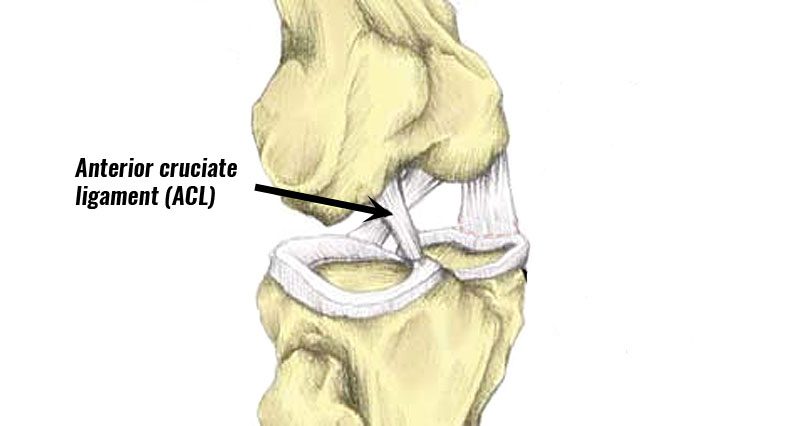
An ACL sprain (anterior cruciate ligament sprain) is a tear or overstretching of the anterior cruciate ligament (ACL) in the knee. It is a common knee injury in sports and typically occurs during sudden changes in direction, twisting, landing, or direct impact.
Medically reviewed by Dr Chaminda Goonetilleke, 21st Dec. 2021
What is an ACL sprain?
An ACL sprain is a tear of the anterior cruciate ligament in the knee. The injury can range from a mild sprain (small tear) to a complete rupture, depending on the force involved.
ACL sprains are graded from 1 to 3:
- Grade 1: Mild stretching or very small tear, with little instability
- Grade 2: Partial tear, with some joint looseness
- Grade 3: Complete rupture, with significant instability
The anterior cruciate ligament plays a key role in stabilising the knee joint, particularly during movements involving rotation and changes in direction.
Torn ACL symptoms
Symptoms of a torn anterior cruciate ligament (ACL) include:
- Sudden, severe pain in the knee
- A feeling that something has gone wrong at the time of injury
- An audible “pop” or cracking sound at the time of injury
- Rapid swelling of the knee (in some cases)
- A feeling of instability or the knee giving way when walking or turning
Rapid swelling is caused by bleeding within the joint. This occurs when blood vessels around the ACL are damaged, leading to bleeding into the joint cavity.
ACL sprain assessment & diagnosis

A qualified clinician will assess your knee to confirm an ACL sprain and rule out other injuries. Diagnosis is based on knee stability, your symptoms, and specific clinical tests.
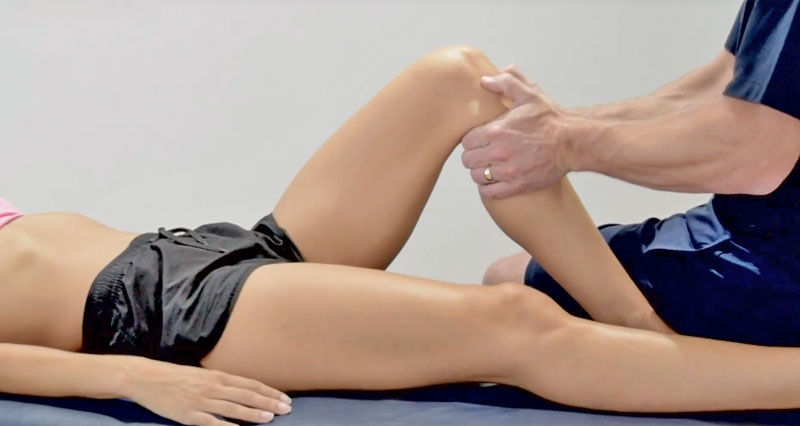
Common assessment tests include:
These tests assess how much forward movement there is in the tibia (shin bone) relative to the femur. Excessive movement suggests damage to the ACL.
Imaging
An MRI scan can confirm the diagnosis of an ACL sprain. An X-ray is only useful for detecting a bony injury, such as an associated avulsion fracture. This is where the ligament tears, pulling a small piece of bone away with it.
- More on ACL sprain diagnosis
Anatomy of the ACL
The anterior cruciate ligament (ACL) runs diagonally through the centre of the knee joint. It connects the femur (thigh bone) to the tibia (shin bone).
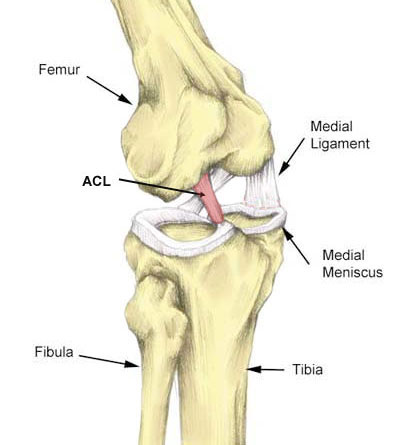
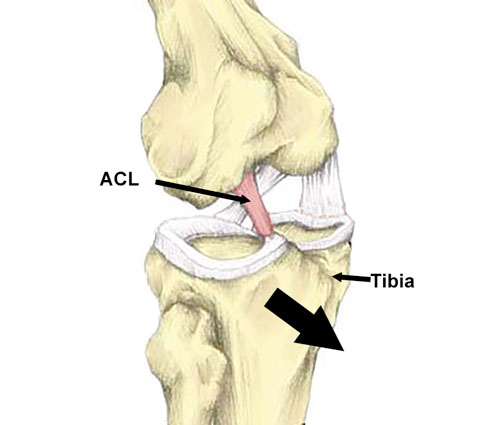
Its main role is to stabilise the knee by preventing the tibia from moving too far forward and controlling rotational movements.
What causes ACL injuries?
ACL injuries usually occur due to a twisting force through the knee.
This often happens when landing from a jump or changing direction quickly, with the foot planted and the knee twisting inwards.
Contact sports
ACL injuries can also occur through contact, particularly in sports such as football or rugby.
A direct blow to the outside of the knee can cause it to buckle inwards, leading to excessive forward movement of the tibia (shin bone) and damage to the ACL and other structures in the joint.
Skiing
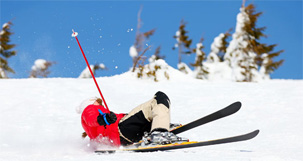
Skiing is another common cause of ACL injuries.
The tips of the skis can catch in the snow, causing the knee to twist under load.
Treatment for ACL sprains
Treatment for an ACL sprain includes immediate first aid, taping or bracing, and rehabilitation exercises. If you suspect an ACL injury or tear, seek professional advice as soon as possible.
Cold therapy & compression
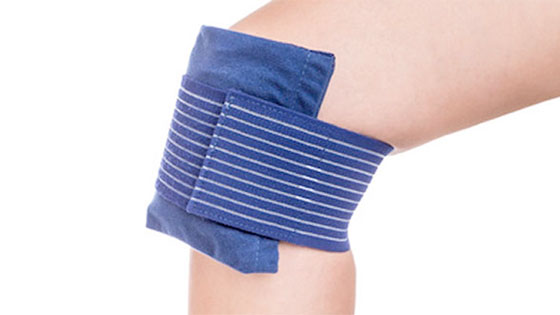
Immediate first aid for ACL tears involves applying the P.R.I.C.E. therapy principles (protection, rest, ice, compression, and elevation) to reduce pain and swelling.
Apply a cold compression wrap for 15 minutes every hour during the first 72 hours, or until a professional assesses your knee. Do not apply ice directly to the skin, as it may cause burns.
Wear a knee brace
Wear a knee support or brace to help protect your knee, especially if it feels unstable. Knee braces vary in price and the level of support they provide.
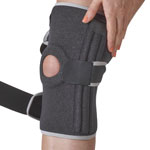
A hinged knee brace has solid side supports to provide additional stability and help protect the ligaments. However, bracing or taping cannot completely prevent injury.
Knee taping
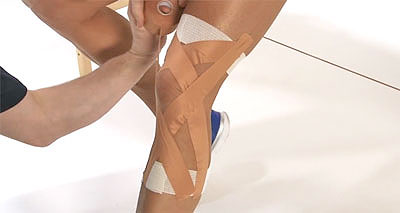
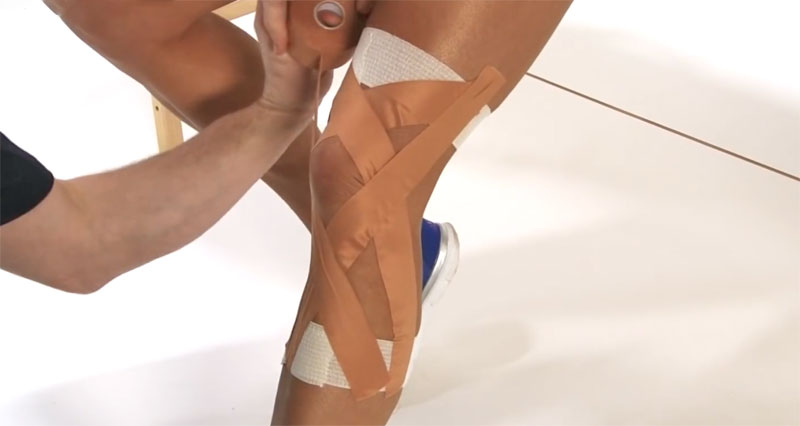
The aim of using a brace or ACL taping is to support the knee after injury and improve confidence when moving. Taping is particularly useful if your knee feels unstable, as it helps protect other structures such as ligaments and cartilage.
Do not tape your knee if you are unsure of the injury or the purpose of taping. This can give a false sense of security and may lead to further damage.
- How to tape for ACL sprain
Seek professional advice
If you suspect a torn ACL, it is important to see a doctor or qualified clinician for a full diagnosis. This may not be possible until the swelling has reduced.
They may refer you for an MRI scan or X-ray to confirm the diagnosis. Depending on the result, you may be advised to see an orthopaedic surgeon.
Rehabilitation for ACL sprains
Elite sports physiotherapist Phil Pask has developed our step-by-step ACL sprain rehabilitation program.
The program is criteria-based rather than time-based, so you progress at your own pace and only move on when you meet specific milestones.
It includes video guidance covering:
- Mobility exercises to restore the normal range of movement in the knee
- Activation exercises to keep key muscles working and prevent weakness
- Movement control (proprioception) exercises to improve stability and reduce reinjury risk
- Strengthening exercises to rebuild muscle support around the knee
- Functional exercises to prepare you for a return to sport
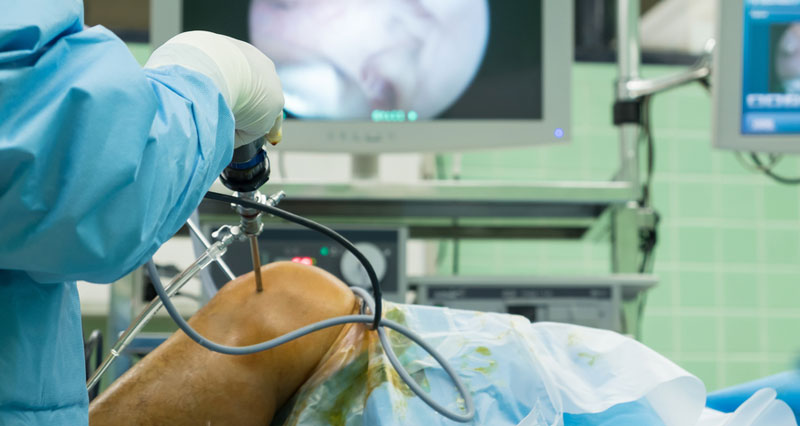
In some cases, surgery may be required. Surgeons often delay the operation until swelling has reduced and normal movement has returned.
- Go to ACL Sprain Rehab Program
Surgery for a Torn ACL
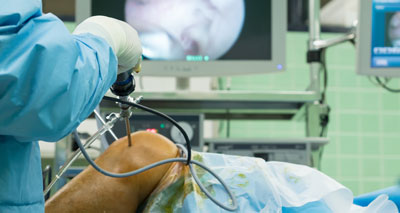
Surgery for a torn ACL is not always required. Whether you are advised to have surgery will depend on your level of sport and activity.
You may be advised to follow a non-surgical (conservative) approach.
- More on ACL surgery
ACL sprain references:
- Boden B.P., Sheehan F.T., Torg J.S. and Hewett T.E. (2010) Non-contact ACL Injuries: Mechanisms and Risk Factors. Journal of the American Academy of Orthopaedic Surgeons, 18(9) pp 520-527
- Magnussen R.A., Reinke E.K., Huston L.H., Hewett T.E. and Spindler K.P. (2016). Factors Associated with High-Grade Lachman, Pivot Shift and Anterior Drawer at the Time of Anterior Cruciate Ligament Reconstruction. The Journal of Arthroscopic and Related Surgery, 32(6), pp 1080-1085
- Culvenor AG, Eckstein F, Wirth W, et al. Loss of patellofemoral cartilage thickness over 5 years following ACL injury depends on the initial treatment strategy: results from the KANON trial. Br J Sports Med Published Online First: 08 February 2019.
- Myklebust G, Bahr R. Return to play guidelines after anterior cruciate ligament surgery. Br J Sports Med 2005;39(3):127–31