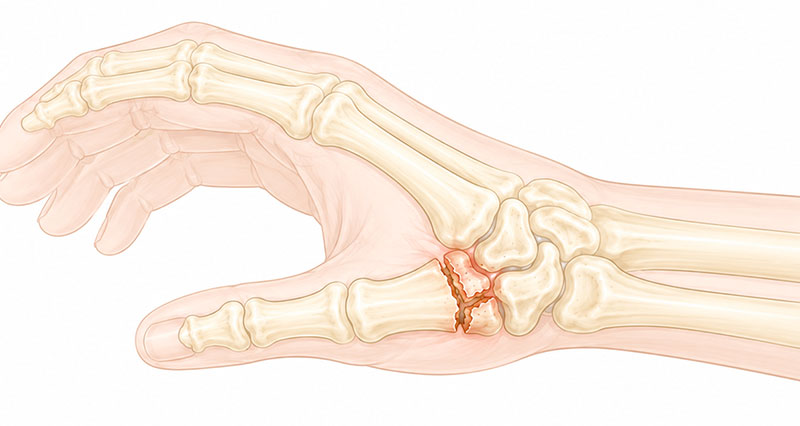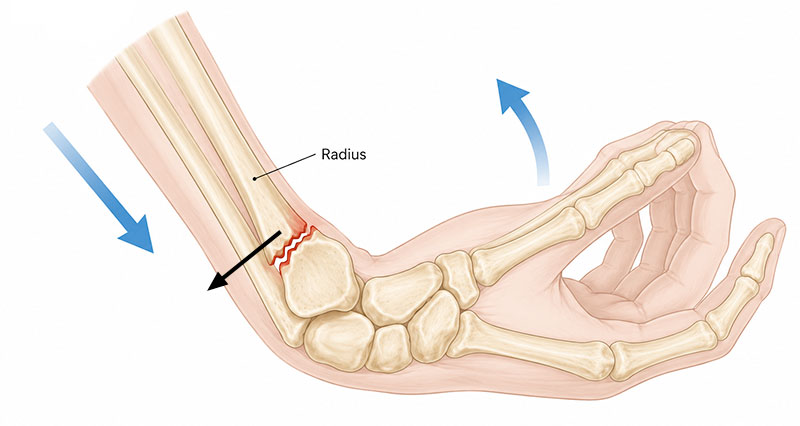
A Smith’s fracture is a break near the wrist end of the radius bone. Unlike the more common Colles’ fracture, the broken fragment is displaced forwards towards the palm side of the wrist. Because of this, it is sometimes known as a reverse Colles’ fracture. It usually occurs after falling onto a bent wrist or from a direct impact to the back of the wrist.
On this page:
ADVERT
Symptoms
Symptoms usually develop immediately following injury and may include:
- Sudden severe wrist pain
- Rapid swelling
- Tenderness over the lower radius bone
- Difficulty moving the wrist or hand
- Visible deformity with the wrist angled forwards
- Bruising may develop over the following hours
- Reduced grip strength
- Possible numbness or tingling in the fingers
If you suspect you may have broken your wrist, seek medical attention immediately. Avoid moving the wrist and support the arm in a sling if possible.
What is Smith’s fracture?
A Smith’s fracture is a fracture at the end of the distal radius closest to the wrist and is named after the Surgeon Robert William Smith who named it in his book published in 1847. The injury occurs from trauma when the wrist is bent (flexed) with the palm down. Also, the broken fragment is pushed forwards towards the palm side of the wrist (volar displacement). It differs from a Colles’ fracture where the fragment moves backwards towards the back of the hand.
ADVERT
What causes a Smith’s fracture?
Smith’s fractures are commonly caused by:
- Falling onto a flexed or bent wrist
- Sports injuries
- Road traffic accidents
- Direct trauma to the wrist
- Falls during skiing, cycling or contact sports
Older adults with osteoporosis are more at risk of wrist fractures following relatively minor falls.
Treatment
Treatment depends on the severity of the fracture and how far the bone fragments have moved.
Immediate first aid
If a fracture is suspected:
- Stop activity immediately
- Support the arm in a sling
- Apply cold therapy to reduce pain and swelling
- Do not attempt to straighten the wrist
- Seek urgent medical attention
ADVERT
Non-surgical treatment
Stable fractures which are not badly displaced may be treated without surgery. Your doctor may gently manipulate the bone back into position before immobilising the wrist in a cast or splint. The cast is usually worn for around 6 weeks while the bone heals. Regular X-rays may be needed to check the fracture remains in position.
Surgery
Many Smith’s fractures are unstable and require surgery to realign and stabilise the bone fragments.
Surgical treatment may involve:
- Metal plates and screws
- Pins or wires
- External fixation devices in severe cases
Following surgery, the wrist is usually immobilised in a cast or splint. After the cast is removed, a rehabilitation program is required to regain full wrist mobility and strength.
Recovery time
Most fractures take around 6 to 8 weeks to heal, although recovery can take longer in more severe cases. After immobilisation, stiffness and weakness are common. Full recovery may take several months depending on:
- Age
- Severity of the fracture
- Whether surgery was required
- Adherence to rehabilitation exercises
Return to sport or heavy activity should only begin once strength and mobility have returned.
Exercises usually begin gently once the cast is removed and progress gradually over time.
Complications
Possible complications following a Smith’s fracture include:
- Wrist stiffness
- Reduced grip strength
- Persistent pain
- Arthritis
- Nerve irritation or compression
- Poor bone healing or malunion
Early treatment and appropriate rehabilitation help reduce the risk of long-term complications.
Rehabilitation exercises
Rehabilitation is important following a Smith’s fracture to restore:
- Wrist mobility
- Grip strength
- Forearm strength
- Hand coordination and function
View more on wrist rehabilitation exercises.
Recommended products for Smith’s fracture recovery
We recommend the following products from our commercial partners (Amazon) for helping with recovery from a Scaphoid fracture:
- Cold therapy wrap: Helps reduce pain, swelling and inflammation during the first few days after injury or surgery. Most appropriate during the acute phase and after rehabilitation exercises if swelling develops.
- Arm sling: Supports and protects the injured wrist whilst waiting for medical treatment or during the early stages of recovery. Helps reduce strain on the fracture site.
- Wrist support: Provides stability, reduces pain and helps confidence when coming out of the cast. Use for 1–3 weeks, then gradually reduce.
- Compression wrist support: Helps reduce mild swelling and improve comfort during later-stage recovery. Best used once healing has progressed and movement exercises have started.
- Therapy putty or hand exerciser: Rebuilds grip strength and targets muscles weakened during immobilisation. One of the most effective rehab tools.
- Hand exerciser/grip strengthener: Allows progressive resistance training and helps with return to sport-specific activity.
- Resistance bands: Used for wrist flexion, extension and radial deviation to restore full strength, not just grip.
- Cold therapy pack & Gel: Useful in the early rehab phase to reduce pain and control inflammation after exercise.
- Heat therapy: Helps reduce stiffness once swelling has settled and is useful before mobility exercises.