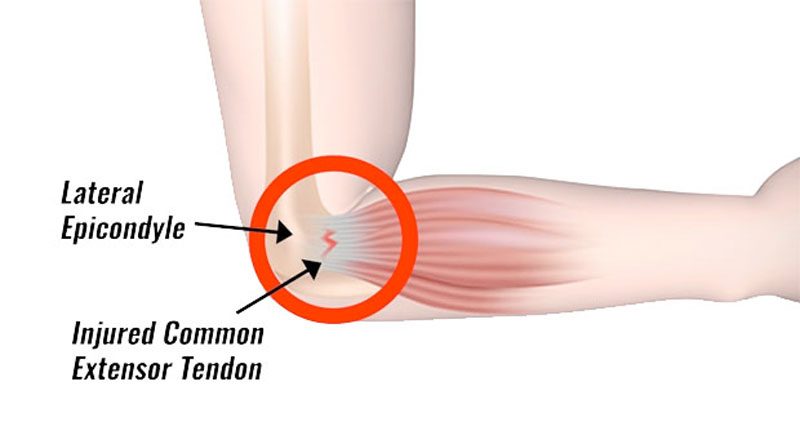
Tennis elbow is also known as lateral epicondylitis, lateral elbow tendinopathy, or extensor tendinopathy. It is a common term used to describe long-term, chronic pain on the outside of the elbow.
Tennis elbow symptoms
Symptoms usually develop gradually over time becoming progressively worse and include:
- Pain approximately 1 to 2 cm down from the bony protrusion (lateral epicondyle) on the outside of the elbow.
- Symptoms may flare up suddenly but they usually develop gradually over time.
- You may have weakness in the muscles around the forearm and wrist.
- As a result, performing simple tasks such as gripping objects, opening a door handle, or shaking hands is painful.
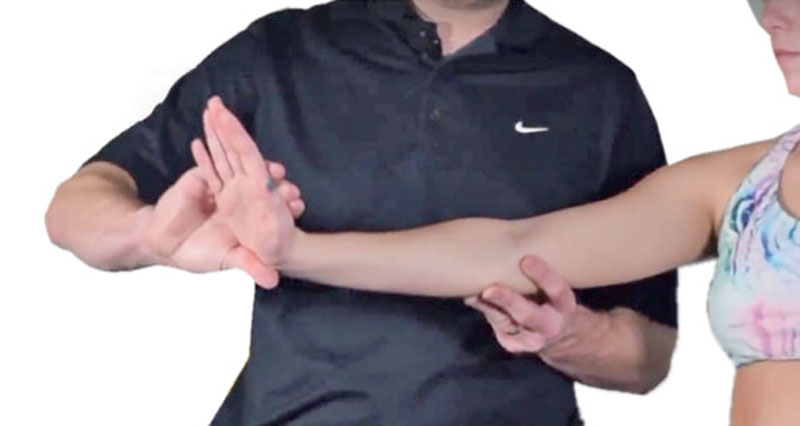
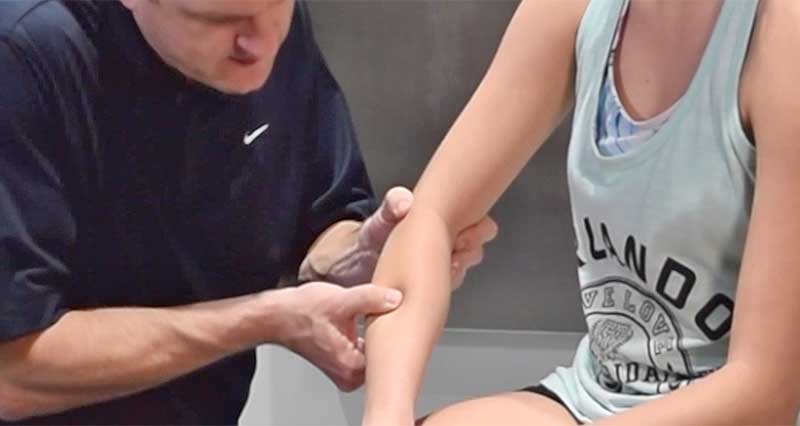
- A professional therapist may perform a number of specific assessment tests including resisted wrist extension, ‘Mills manoeuver’ and the ‘neural tension’ to help diagnose lateral elbow pain.
Read more on Tennis elbow diagnosis.
What is Tennis elbow?
It is a general term people use to describe pain on the outside of the elbow. However, the specific diagnosis may be lateral epicondylitis, which is tendon inflammation. Or more likely, tendinopathy, which describes wear and tear or degeneration of the tendon.
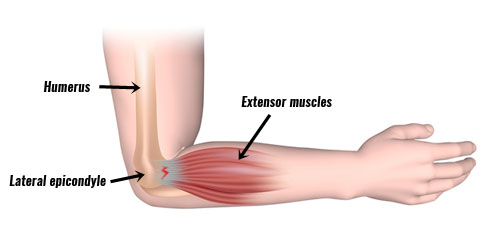
The wrist extensor muscles attach to the lateral epicondyle (bony bit) on the outside of the elbow. Tennis elbow pain usually occurs where the tendon of the ‘extensor carpi radialis brevis’ muscle inserts into the bone2. At this point, there are a large number of pain receptors. As a result, the region is particularly tender to touch. Symptoms are either acute or chronic.
Acute Tennis elbow
Acute injuries occur immediately after an activity such as hitting a backhand shot in tennis with poor technique.
The extensor muscles on the back of the forearm (wrist extensors) become suddenly overloaded. This causes small micro-tears in the tendon where it attaches to the elbow.
Chronic Tennis elbow
Chronic injuries normally develop over a period of days/weeks. It often follows a bout of intense exercise or unaccustomed activity. For example, lifting heavy boxes and other DIY jobs.
Is it lateral epicondylitis or extensor tendinopathy?
The medical term often used is lateral epicondylitis. However, this can be misleading as the ‘itis’ on the end of the word implies that there is inflammation.
In long-term cases, the acute inflammatory stage has passed, and tendinopathy is an appropriate term. This is because it describes the degeneration of the tendon rather than acute inflammation.
What causes tennis elbow?
The most common cause of Tennis elbow is overuse or repetitive strain. In particular, repeated extension (bending back) of the wrist. For example:
- Gripping or turning objects like a manual screwdriver.
- Lifting heavy weights during strength training.
- Repeatedly performing occupational activities, such as lifting bricks.
Tennis technique
The injury got its name because it played a backhand in Tennis with poor technique surefire way to cause injury. The huge force of the ball striking the racket is transferred through the forearm and is focussed at a point on the outside of the elbow.
This is made worse if your wrist is bent when striking the ball. This is because the forces are transmitted through the muscle and tendon, rather than the whole arm. Therefore, It is not an injury that affects regular players as they are likely to have good technique and strength.
Other factors related specifically to tennis include:
- Gripping the racquet too tightly
- Having racket strings too tight
- If the grip is too small.
All these results in the forearm muscles overworking.
Tennis elbow treatment
Treatment for Tennis elbow or lateral epicondylitis involves reducing pain and inflammation, then gradually increasing the load through your elbow with exercise. No single treatment on its own is likely to be effective. Use a combination of approaches.
Immediate first aid
If your elbow is acutely painful or you have recently noticed it, then for the first 72 hours post-injury, apply the principles of P.R.I.C.E. (Protection, Rest, Ice, Compression, and Elevation).
Rest
Rest is probably the most important part of treatment and is often difficult to do. If you continue to use the painful elbow then it will not recover as quickly and may become chronic and very difficult to treat.
Avoid gripping heavy things, opening heavy doors, using a screwdriver and of course, playing a backhand in tennis.
Ice/cold therapy
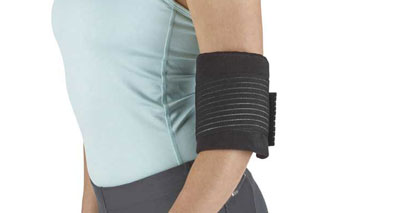
Apply ice or a cold compression wrap to reduce pain and inflammation, especially if your elbow is acutely painful.
Apply the cold for no more than 15 minutes as the injured tissues are very close to the skin and do not need longer. Wrap ice in a wet tea towel to avoid ice burns. Or better still use a commercially available cold therapy compression wrap.
Medication
Your doctor may prescribe medication such as Ibuprofen. This helps reduce pain and inflammation in the early stages. However, long term it may not be effective. Do not take Ibuprofen if you have Asthma.
Wear a Tennis elbow brace
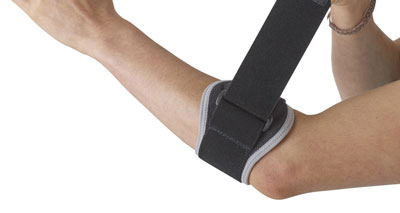
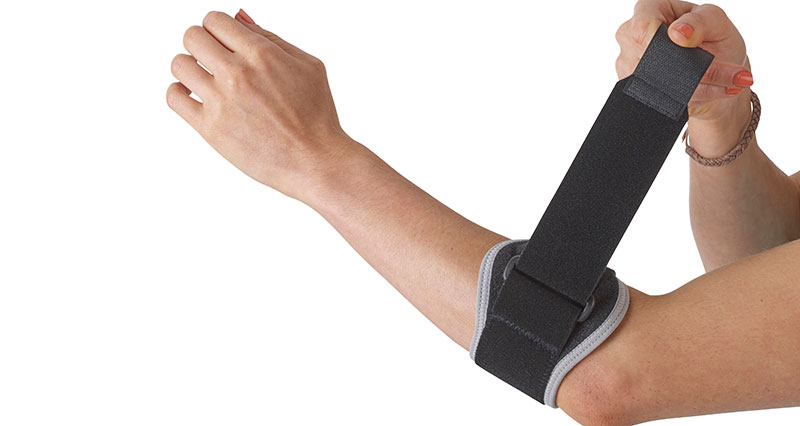
Wear a Tennis elbow brace or support. This helps reduce the strain on the tendon enabling healing to take place. It works by applying compression around the upper forearm. As a result, pressure on the painful tendon causes forces to transmit differently. Therefore reduces pain and inflammation and allows your Lateral epicondylitis to heal.
A simple neoprene elbow sleeve also helps by supporting the joint in general and retaining heat, which is probably more beneficial for more long-term chronic injuries. It is often personal preference or trial and error to find which works best for you.
Read more on how to use a Tennis elbow brace.
Massage
Sports massage can be a useful treatment for tennis elbow, particularly more chronic conditions. In particular, cross friction massage of the tendon, but only once the initial inflammation has settled. This is usually after 5 days.
Deep tissue massage for the muscles of the forearm can release any tight knots, lumps, and bumps that might increase the stress on the tendon attachment point.
Electrotherapy
Your therapist may choose to use different types of electrotherapy equipment to treat the symptoms. Some of the methods commonly used include the following:
Ultrasound involves passing high-frequency sound waves into the soft tissues. Ultrasound causes molecules to vibrate giving a micomassage effect. It also generates heat if applied continuously as opposed to in pulses.
The laser works by passing high-intensity light into the tendon to reduce pain, and inflammation and encourage cell reproduction. No heat is generated with laser treatment.
Extracorporeal Shock Wave Therapy works by passing short but intense energy waves into the tissues.
Acupuncture
In some cases. dry needling or Acupuncture is an effective treatment for tennis elbow. It involves inserting needles of various lengths and diameters into specific points around the forearm and surrounding areas.
The practitioner inserts needles, rotates them then leaves them in place for several minutes. The theory is that it alters the way pain signals transmit via nerve pathways.
Corticosteroid injections
Another treatment for Tennis elbow is injecting corticosteroid drugs into the area. Current evidence has shown them to be effective in the short term but harmful over the long-term. As a result, they are not recommended in most cases.
In order to improve the chances of a good end result, the patient often requires a series of injections over a period of weeks or months as opposed to a one-off injection. The steroid should be injected around the area of the tendon attachment and not into the body of the tendon as there have been cases of tendon ruptures following steroid injections.
Other treatments
Nitric oxide donor therapy patches are applied to the elbow. These may be beneficial over a period of months, although approximately 5% of patients will have side effects including headaches and skin rashes.
Botox injections – are thought to improve short-term pain relief although there is a very high likelihood that the forearm muscles will not function properly afterwards.
Autologous blood injection – involves centrifuging the patient’s own blood to separate the plasma from the red blood cells. The resulting plasma is rich in platelets that are effective for healing. This is then injected back in and around the site of injury. It is thought to re-initiate or enhance the inflammation repair response.
Exercises for Tennis elbow
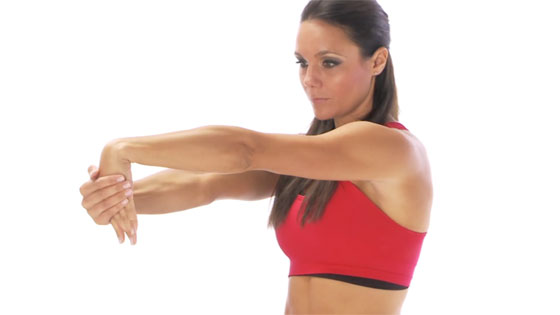
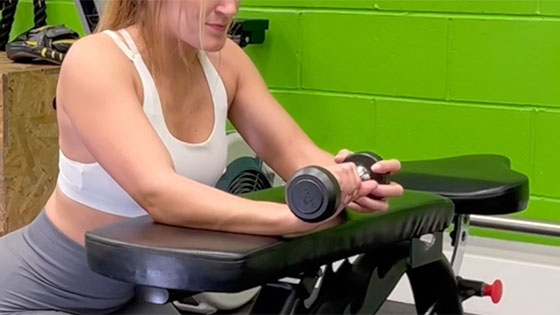
Both stretching and strengthening exercises4 are important for treating Tennis Elbow and provide the foundation for a rehabilitation program.
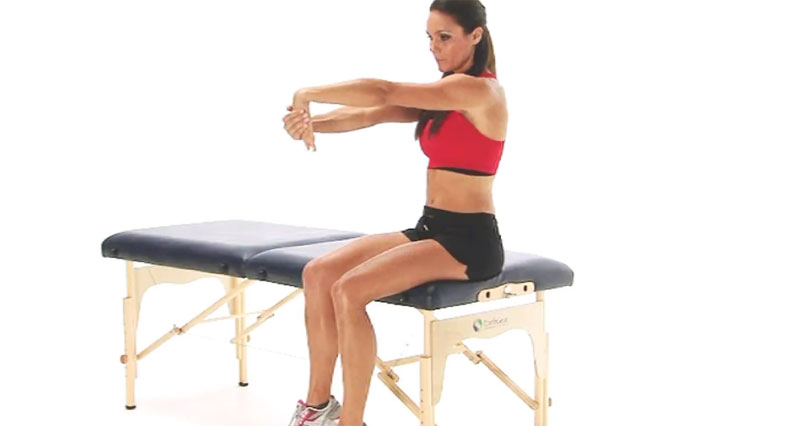
Perform stretching exercises as soon as pain allows. Continue stretching until you are fully it and beyond. The most important stretching exercise is to stretch the wrist extensor muscles.
- More on Tennis elbow exercises
Tennis elbow surgery
Both golfer’s elbow and tennis elbow are similar manners when it comes to surgery. Surgical treatment of tennis elbow consists of recessing and releasing the portion of the frayed or diseased tendon. In other words, removing it from the bone.
Modern techniques usually involve endoscopic (keyhole surgery). A very small incision is made rather than opening up the area. The principle of tennis elbow surgery is the same whatever the surgical technique. That is to release the damaged tendon from the bone.
How long until I have recovered?
The vast majority of cases respond to conservative treatment (nonsurgical). However, if surgery is required then the recovery time is around 8 weeks.
References
- Fairbank SM, Corlett RJ. The role of the extensor digitorum communis muscle in lateral epicondylitis. J Hand Surg Br 2002;27B(5):405–9.
- Milz S, Tischer T, Buettner A et al. Molecular composition and pathology of entheses on the medial and lateral epicondyles of the humerus: a structural basis for epicondylitis. Ann Rheum Dis 2004;63(9):1015–21.
- Coombes BK, Bisset L, Vicenzino B. A new integrative model of lateral epicondylalgia. Br J Sports Med 2009;43(4):252–8.
- Pienimäki T, Karinen P, Kemilä T et al. Long-term follow-up of conservatively treated chronic tennis elbow patients. A prospective and retrospective analysis. Scand J Rehabil Med 1998;30(3):159–66.
- https://www.bmj.com/content/342/bmj.d2687