The following exercises are examples of those that may be used in the rehabilitation of a lateral cartilage meniscus injury. Both mobility, stretching, strengthening and proprioception exercises are important.
The following is for information purposes only. We recommend seeking professional advice before attempting any rehabilitation exercises.
The following exercises which are split into early-stage, mid stage and late stage exercises. Rehab exercises can begin as soon as pain allows.
Lateral meniscus tear mobility exercises
It is important to avoid sideways (lateral) movements in the early stages while your torn ligament is healing.
Flexion/Extension Exercises
This exercise is extremely important not only to improve the mobility of the injured knee but it will also help maintain the strength of the quadriceps and hamstrings in the early stages of rehabilitation. These movements can also help to decrease the swelling surrounding the knee.
- Sit on the edge of a bench or chair. In the early stages, it is best to sit on a seat that is high enough to allow the feet not to come in contact with the ground. This makes the exercise easier.
- Slowly bend (flex) and straighten (extend) the knee within the limits of pain.
- Aim for 3 sets of 10-20 repetitions 3 times a day as pain allows.
Progress this exercise to holding the leg in place at the end of the possible range, both in flexion and extension. This will aid in strengthening the muscles.
Knee Flexion
This exercise mainly targets the hamstring muscles which are the main flexors of the knee. It will also help to stretch the quadriceps at the front of the thigh.
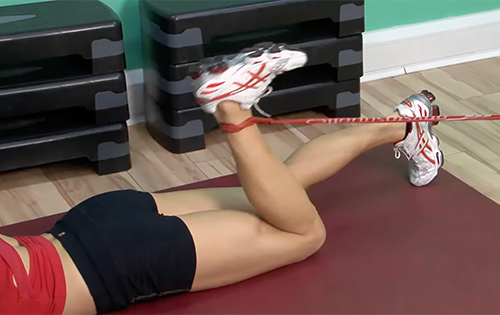
Teaching point:
- Lie face down and flex the injured knee as far as possible.
- Repeat this exercise 10 times.
- Hold the knee at the end of range for 5-10 seconds, as exercise becomes easier
- Repeat 1 to 3 times a day.
Heel Slides
The aim is to improve knee mobility. Hence, in the early stages of recovery, this may be done by wearing a thick sock and sliding the foot along a polished floor as opposed to a carpet.
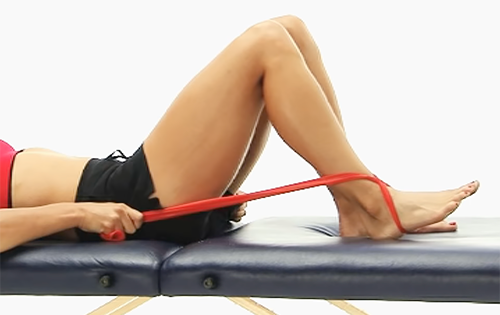
Teaching point:
- Lie on your back, bend one knee whilst sliding the foot firmly on the ground.
- Slide your heel up as far as possible towards your buttocks.
- In the early phases of recovery, it may only be possible to attain as little as 30 degrees flexion. This range of movement, with repetitions, should increase over time.
- Repeat 10 to 20 times daily, aiming to increase the range of movement as pain allows
If there is insufficient muscle strength to bend the knee, the exercise may be made easier by using a towel around the ankle to facilitate flexion (as shown).
Light, low resistance exercises such as swimming and light exercise bike training can also aid to increase the range of mobility. However, these are normally only advised when a satisfactory range of movement has been achieved.
Stretching exercises
The aim of stretching is to increase the range of movement at a joint by increasing the flexibility of the soft tissue structures that surround it i.e. muscles, ligaments, and the joint capsule. Stretching exercises are extremely beneficial in rehabilitation but should normally be accompanied by a strengthening program so that instability does not develop around the joint. A number of stretching exercises can be used following an injury to the medial meniscus. As always these should only be carried out as pain allows.
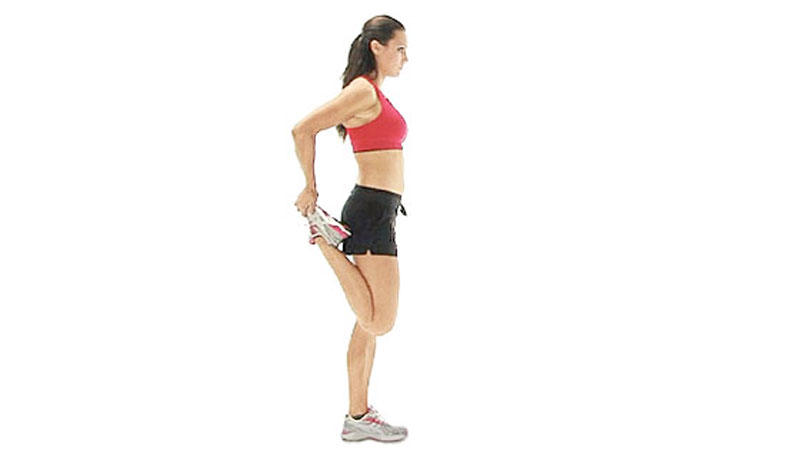
Hamstring stretch
Hamstring stretches can be done in a number of ways either sitting, standing or lying down.
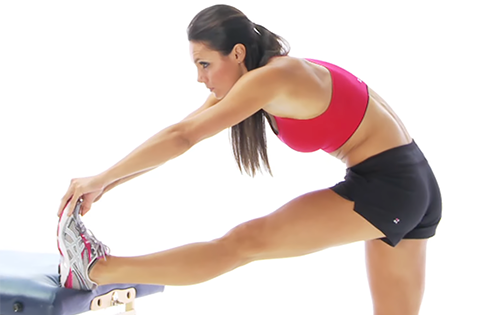
Teaching point:
- Gently take the leg to the limit of its comfortable range until a gentle stretch is felt at the back of the thigh
- Hold for 20 to 30 seconds and relax
Play standing hamstring stretch video
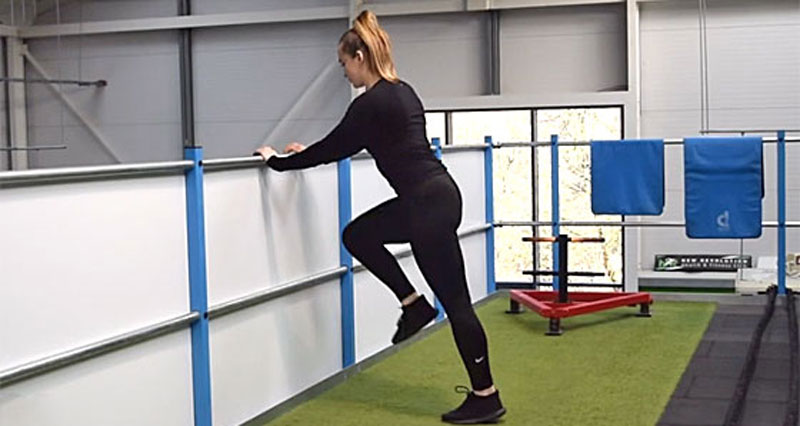
Calf Stretches
This stretch increases flexibility not only in the calf muscles but also in the hamstrings.
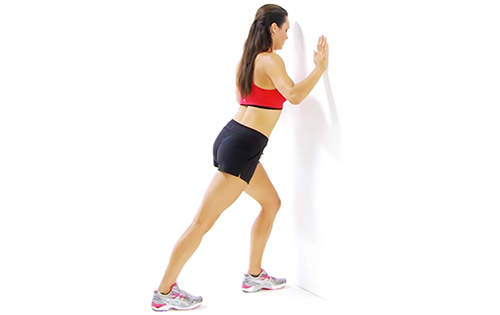
Teaching point:
- Place the injured leg one pace behind the other.
- Keep the knee straight and the heel on the floor as you lean forwards (stand in front of a wall for balance!)
- A stretch should be felt at the back of the behind leg
- Hold for 10 seconds and release slowly
- Repeat 3 times daily
Also, perform this stretch with the knee slightly bent.
This will relax the gastrocnemius muscle (which is stretched when the knee is straight) and instead allow the focus of the stretch to be on the soleus muscle.
Early-stage lateral meniscus tear strengthening exercises
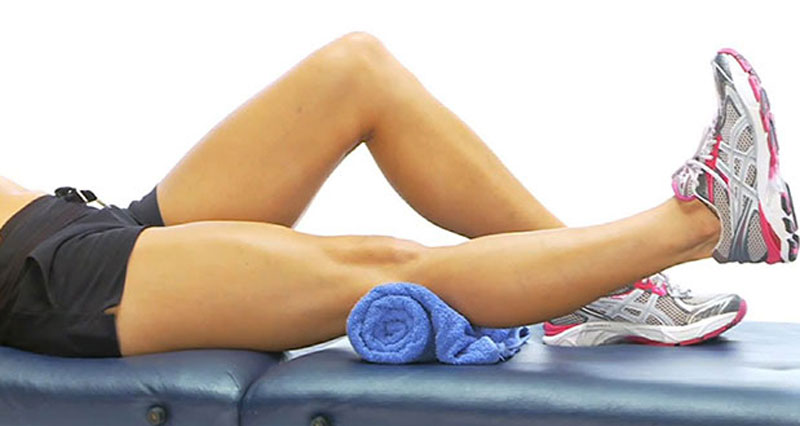
Static Quadriceps Contractions
This exercise is used to prevent quadriceps muscles from wasting away in the early stages of injury. In this stage, weight-bearing and more difficult exercises may be either not advised or too difficult. This exercise may be started as soon as pain will allow and done on a daily basis.
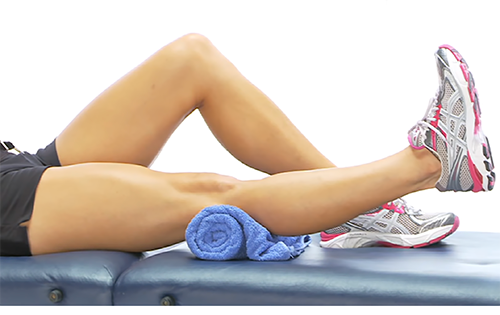
Teaching point:
- Contract the quad muscles, hold for a count of 10 and relax
- Repeat 10 to 20 times
- This can be performed either flat on the floor, or with a foam roller or rolled-up towel under the knee
Static Hamstring Contractions
This exercise is more difficult than the one above and also helps in increasing the range of movement in the knee joint.
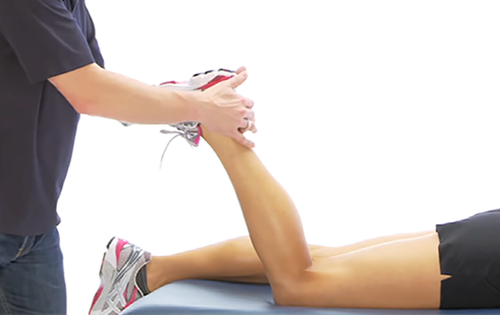
Teaching point:
- Lie on your front in the prone position
- A partner or therapist provides resistance as you contract the hamstring muscles, hold for 3 or 4 seconds then relax
- Change the amount your knee is bent to work the muscle at different lengths
- Once a range of angles has been worked repeat the exercises with your foot turned outwards and again with your foot turned inwards
- This exercise targets the inner and outer hamstring muscles at varying angles of flexion or knee bend
Mid-stage lateral meniscus tear exercises
Straight Leg Raises (SLR)
This exercise is more difficult than the static quadriceps exercise as it involves lifting the entire weight of the leg against gravity.
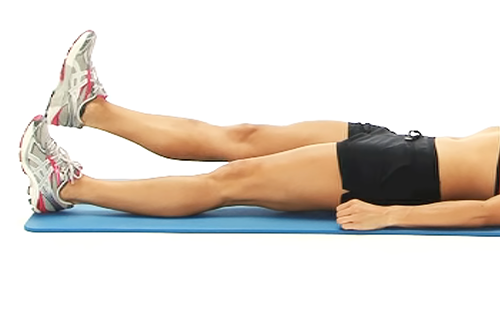
Teaching point:
- Position yourself sitting on the floor with both legs straight out in front of you
- Raise the straight leg off the floor and hold for 10 seconds
- Relax, rest for 3 seconds and repeat 10 to 20 times
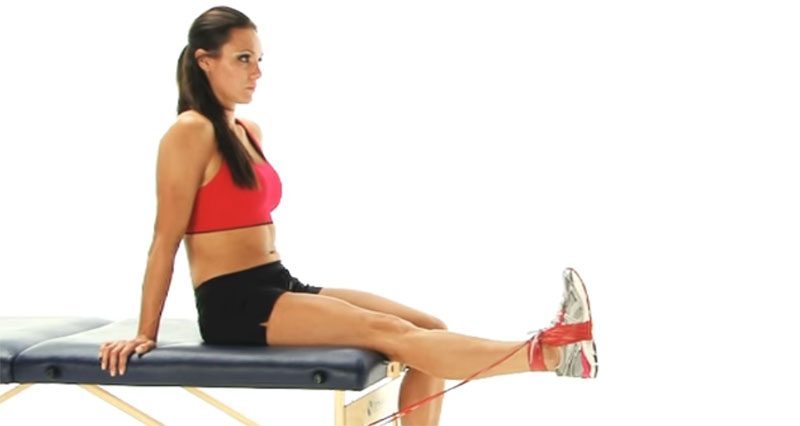
Knee Extension
This exercise specifically targets the quadriceps muscle group.
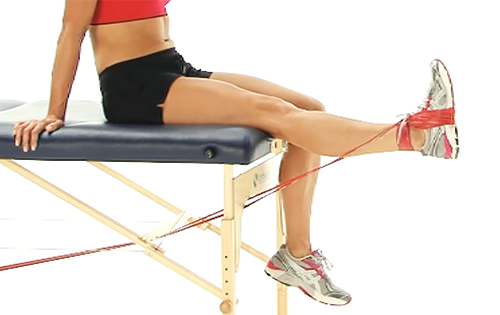
This exercise can be used relatively early in the rehab process but care should be taken not to overload the injured leg. It can be done with a weights machine in a gym or with a rehab band as shown.
Leg Curl
You can perform this with either ankle weights, a resistance band or a weight machine. Aim for 3 sets of 10 repetitions initially with light weights/low resistance and gradually increasing.
Hip Raises (Bridging)
This works the hamstrings and buttock muscles.
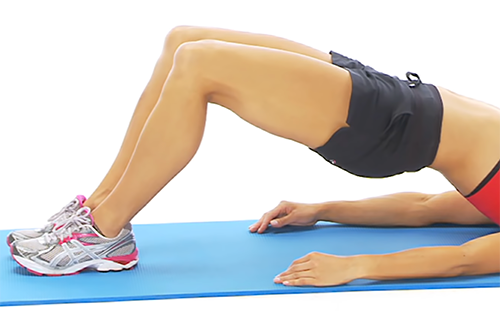
Teaching point:
- Lie on your back with your knees bent and feet flat on the floor
- Lift your hips up off the floor as far as they will go, hold for 3 seconds and lower
- Repeat 10 to 20 times
- To progress this exercise, increase the length of time that the hips are held up, initially to 5 and then to 10 secs
Calf Raises
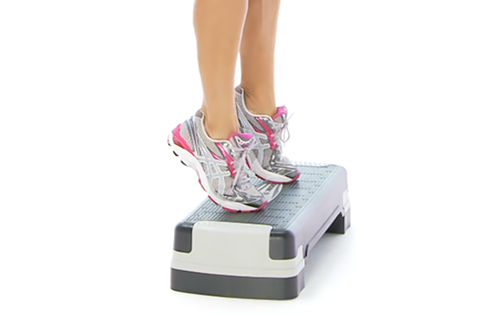
Teaching point:
- Raise up and down on the toes on the edge of a step in a smooth movement
- Aim for 3 sets of 20 repetitions
- This exercise can be progressed to single-leg calf raises as fitness and tolerance increases
Late Stage Exercises
Squats
This is arguably the best exercise to increase quadriceps muscle strength. Nevertheless, extreme care should be taken with this exercise as it involves large loading of the quadriceps muscles and the knee joint itself
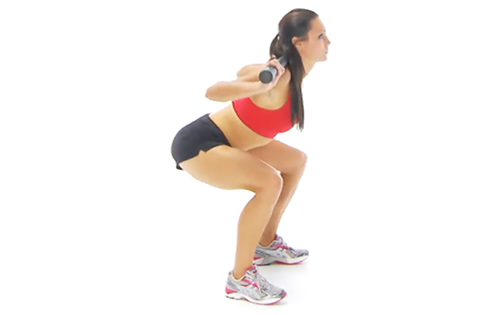
Teaching point:
- Squat down halfway to horizontal and return to standing
- Try to sink down through the knees, keeping the back straight and not allowing your knees to move forwards past your toes
- Return to the start position and repeat
- Aim for 3 sets of 10 repetitions during rehabilitation
- Progress this exercise by adding weight or moving to single-leg squats
Later in the rehabilitation process, squats can be progressed to horizontal (90 degrees flexion at knee and hip)
Hip Flexor Exercises
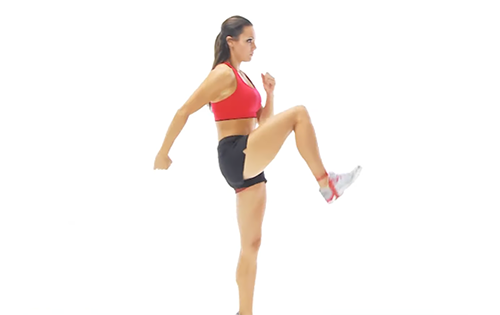
Teaching point:
- Start with the band tied around your ankle and also something close to the floor.
- Make sure you have something to hold on to.
- Raise the knee up towards the chest, against resistance
- Slowly return to the start position and repeat.
- Aim for 3 sets of 10 repetitions.
If you do not have rehabilitation band or suitable weights then this exercise can be done without resistance. However, in this situation, more reps should be added to the rehab program.
Hip Adduction Exercises
The hip adductors are better known as the groin muscles.
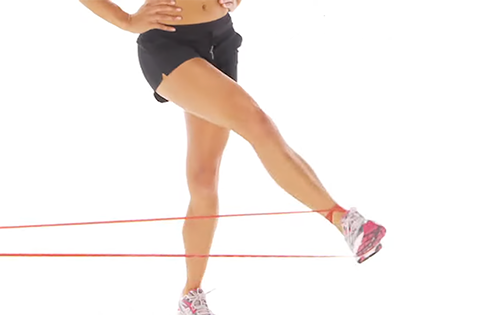
Teaching point:
- Attach a resistance band around your ankle and then fasten it to a secure object, to the side of you
- Start with the leg out to the side, away from the body, with the knee straight
- Pull the leg across your body as far as comfortable, before slowly returning back to the start position
Hip Abduction Exercises
The hip abductors are vital components in gait as they allow the hips to support the weight of the body. Thus strengthening exercises for this muscle group is vital to any lower limb rehabilitation program. These can be performed in lying in the acute stage and progressed into standing with a resistance band.
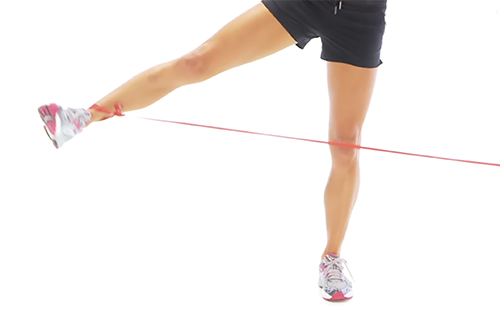
Teaching point:
- Tie the band around your ankle and around a sturdy object to the side of you.
- Start with the leg to be worked on the opposite side to the attachment point
- While keeping the leg straight, take the leg out to the side as far as comfortable
- Slowly return to the start position.
This exercise can be progressed using elastic bands to increase resistance.
Propriocepton Exercises
Proprioception can be considered as the body’s ability to sense where it is in space. In the event of an injury, this mechanism becomes disrupted and proper training is needed to re-educate the muscles to fire at the right time to allow further injury prevention.
The most common way to achieve this is to first stand and then walk on an uneven surface. As balance continues to improve proprioceptive exercises can progress as follows:
Wobble board exercise
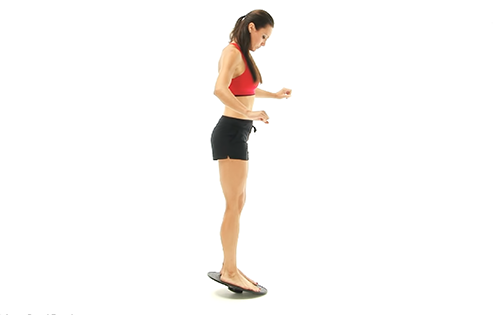
Teaching point:
- Two footed stand on wobble board -aim to maintain balance for as long as possible
- Progress to one-legged (injured side) wobble board exercises
- Practice hopping on the injured leg on an uneven surface
- Gradually increase difficulty by throwing a ball against a wall and catching it while standing on the wobble-board. Aim to challenge yourself by throwing the ball outside your comfortable center of gravity.
Proprioceptive exercises should be continued even after a return to full fitness to prevent future injury.