Frozen shoulder exercises include mobility, stretching and strengthening with information on which stage of frozen shoulder might be appropriate.
Mobility exercises
The following exercises focus on mobility. They are important in the early stages of frozen shoulder rehabilitation and should be done regularly every day. They may be uncomfortable but should not be painful.
Pendulum exercises
Pendulum swinging of the arm is a great exercise for a frozen shoulder and a gentle way of improving mobility.
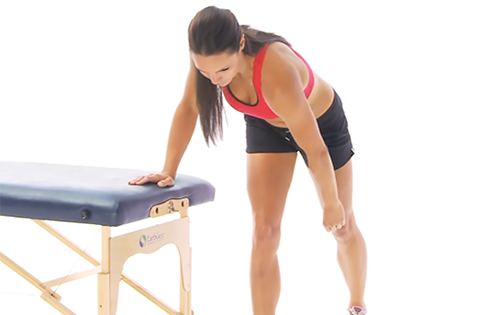
Teaching point:
- Stand in a slightly bent-over position and support the body weight with the unaffected arm on a chair or table
- Swing the affected arm in back and forth and circular motions, starting small and gradually increasing the movement
Pole exercises
Pole or wand exercises are a useful way of increasing the range of motion at the shoulder.
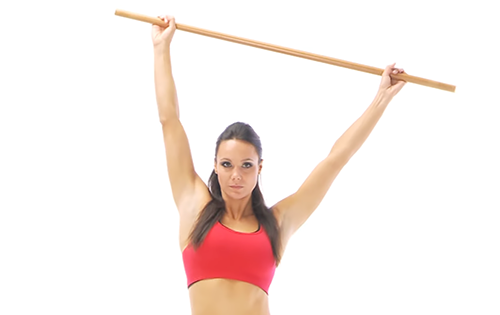
Teaching point:
- Using a long object such as a broom handle held in both hands, the affected shoulder is taken out to the side as far as possible
- Apply pressure using the good arm and broomstick to try to push it a bit further
- Hold for 10 seconds and try to push a bit further again
Note: This can be done in a number of positions.
Frozen shoulder stretching exercises
Stretching exercises can be performed during the freezing phase and the frozen phase but only if they can be done pain-free. Unlike pendulum mobility exercises they should not be uncomfortable to perform.
Supraspinatus stretch behind the back
The following exercises continue from mobility exercises and focus on frozen shoulder stretching exercises.
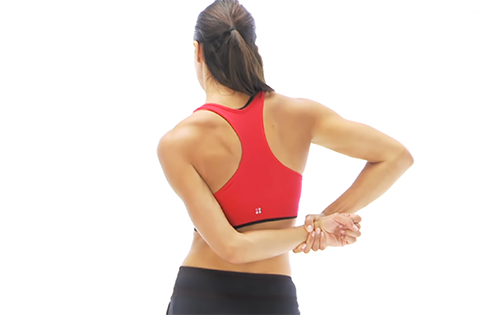
Teaching point:
- Extend one arm behind your back, elbow bent, and grab the elbow with your free hand
- Gently pull it across your body, holding the position once you feel a targeted stretch in your shoulder
- Maintain a steady breath, ensuring comfort and alignment throughout
Shoulder flexion stretch
Teaching point:
- Kneel on all fours and keep your hands in the same spot
- lower your buttocks towards your heels
- This increases the degree of flexion at the shoulder joint
- Hold this position at the point when you feel a gentle pulling sensation
- If this eases, sit back a little further
- Hold for 30 seconds, rest and repeat 2 more times
Chest Stretch

Teaching point:
- Position the forearm against the wall, with the elbow bent and the upper arm horizontal
- Lean slightly forwards and rotate the body away from the wall until a stretch is felt in the chest and front of the shoulder
Note: If the arm is kept straight whilst performing this exercise then more of the stretch will be applied to the shoulder rather than the chest.
Posterior Shoulder Stretch
This exercise stretches the back of the shoulder.

Teaching point:
- Bring the arm across the body at chest height
- Use the other hand to pull it in until a stretch is felt in the back of the shoulder and the upper back
Strengthening exercises
Frozen shoulder strengthening exercises can be used to maintain the strength of the shoulder as much as possible. Isometric or static exercises are the easiest to perform and will cause the least discomfort.
Strengthening exercises should be performed when pain allows. Initially, static exercises performed against an immovable resistance can be done. We also cover shoulder blade stabilizing exercises which should be included in all shoulder rehabilitation programs.
Isometric shoulder exercises
Abduction – This is performed standing sideways against a wall, with the arm straight and by the side. The arm is pushed outwards, against the wall. Hold for 5-10 seconds, rest and repeat 5-10 times.
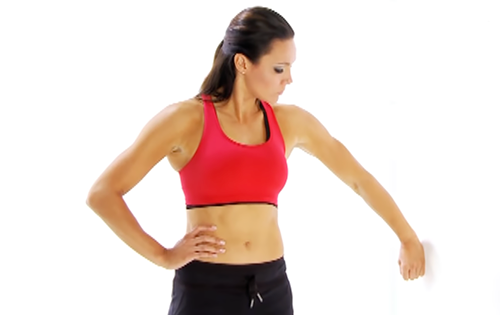
External Rotation – Again standing sideways on, with the elbow bent to 90 degrees and the upper arm by the side. The back of the wrist is pushed against the wall as if trying to rotate the arm at the shoulder. Hold for 5-10 seconds, rest and repeat 5-10 times.
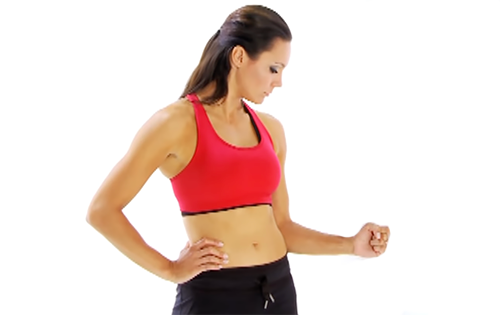
Internal Rotation – Standing face on to a corner such as a door frame, the elbow is bent and the upper arm by the side. The front of the wrist is pushed against the wall as if trying to rotate the shoulder so the forearm would move towards the stomach. Hold for 5-10 seconds, rest and repeat 5-10 times.
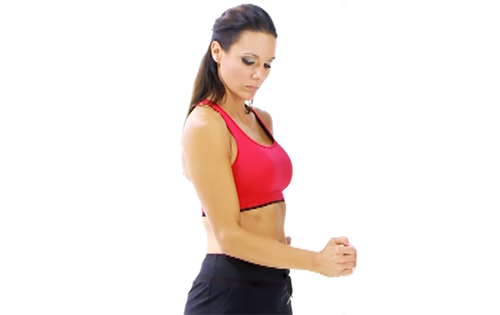
Scapula squeeze
This strengthens the rhomboids and middle trapezius.
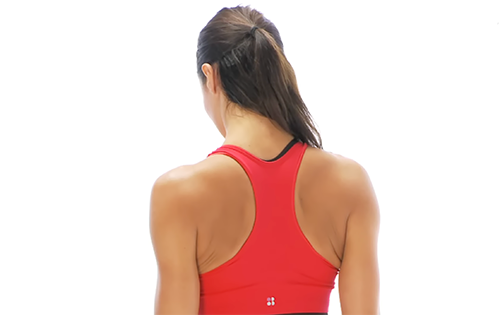
Teaching point:
- Start with the arms by the sides and the shoulders relaxed (dropped away from the ears!)
- Squeeze the shoulder blades together and down the back
- Hold for 5 seconds, rest and repeat
- Begin with three sets of 10 repetitions daily.
Hands up exercise
This exercise works the muscles at the back of the shoulder and the shoulder blade.
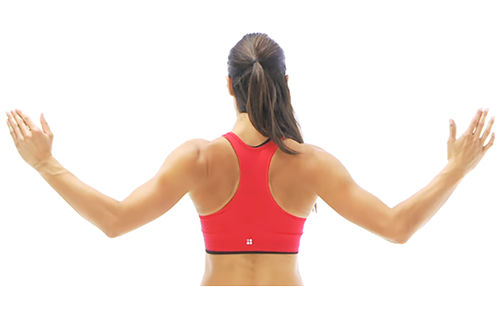
Teaching point:
- Start with the arms by the sides and shoulders relaxed as above
- Bend the elbows and bring the arms up, rotating the shoulders, until the palms face forwards as if surrendering!
- As you do this, squeeze the shoulder blades together, gradually increasing the movement