Concussion has gained a lot of attention in sports over recent years. As a result, research on identifying and preventing a concussion means we understand this potentially serious brain injury much better.
What is a concussion?
The Concussion In Sport Group (CISG) defines a sports-related concussion as a ‘traumatic brain injury induced by biomechanical forces’. In layman’s terms, this means trauma to the brain from impact or shaking.
A direct blow to the head, face, neck, or in fact, any part of the body causes it. As a result, sudden forces transmit into the head.
Always treat a concussion seriously. Even mild symtoms can cause much longer term problems or mental health issues.
A concussion can result in the rapid onset of short-lived impairment of brain function. Often it occurs spontaneously, but in some cases, features of a concussion can evolve over several minutes or even hours.
Symptoms are mainly due to a disturbance or disruption in how your brain functions and not due to a structural injury. Therefore, routine neuroimaging (MRI scans) will not show any abnormality.
Concussion results in a range of clinical signs and symptoms which could, but not always involve loss of consciousness.
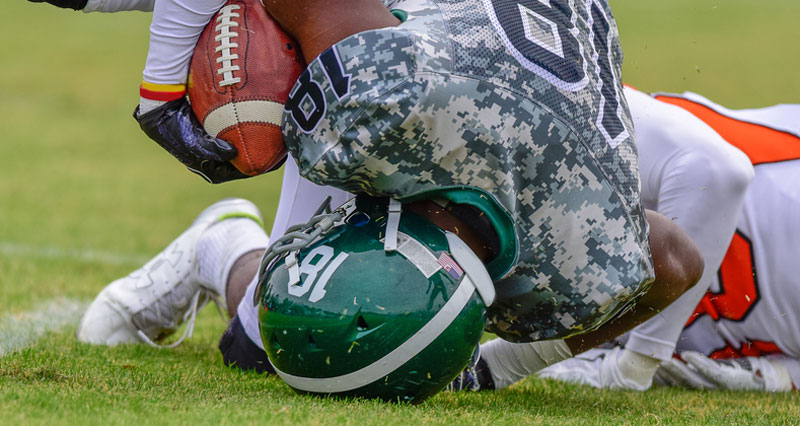
We see it most often in contact sports like Rugby, American football,
Recognising Concussion
If you suspect a concussion, remove the player IMMEDIATELY from the training session or match. NEVER leave them alone.
Consider several areas when recognising or diagnosing concussion. These include symptoms such as:
- Headache
- Neck pain
- Nausea or vomiting
- Dizziness
- Blurred vision
- Sensitivity to light and/or noise
- Feeling slowed down
- Fatigue
- Low energy.
Often athletes would say they are feeling like they are ‘in a fog’, ‘don’t feel right’ or have ‘pressure in the head’. Some could be drowsy or confused. Others may be more nervous or anxious than usual, or more emotional, sad or irritable.
Sleep disturbance is also common with trouble falling asleep. Players who have a concussion may have impaired balance as well as difficulty concentrating or remembering.
However, these symptoms are not specific to a concussion. Therefore they cannot diagnose or indicate concussion 100%.
Always seek professional medical advice to determine the extent of a head injury. Under no circumstances return to playing sport until a doctor assesses the injury.
How do I know if I have a concussion?
There is no perfect diagnostic test to immediately diagnose a concussion.
Doctors may use a test called the SCAT5 to assess a possible concussion.
SCAT stands for Sports Concussion Assessment Tool developed by the CISG and is currently in its 5th edition.
It has been developed over a number of years to be sensitive enough to detect subtle symptoms and monitor the progress of an athlete as they recover from a possible concussion.
The test is very detailed and consists of several questions and short physical and mental tests to assess the athlete’s symptoms, including their ability to balance and their ability to memorise, and recall information.
Certain sporting bodies have their own tools to assess head injuries. For example, Head Injury Assessment Tools 1,2 & 3 were introduced by World Rugby for use in elite professional teams.
Medical assessment
The doctor will perform the immediate or on-field assessment part of SCAT5 soon after the incident. They will then repeat the test later in a distraction-free environment. Repeat the SCAT5 over a period of several days or weeks until the results are back to normal. This may take several weeks.
SCAT5 is a tool for doctors or trained healthcare professionals only. However, anyone can download it here.
For non-healthcare professionals, you can use the concussion Recognition Tool5 (CRT5), this can be downloaded here and is a simplified version of the SCAT5 to assist in detecting if an athlete has suffered a concussion.
A previous concussion is a risk factor for developing future concussions. Multiple previous concussions are associated with physical, cognitive and emotional symptoms.
An adult athlete whose symptoms continue after 2 weeks of the injury (>4 weeks in children) is said to have ‘persistent symptoms’. They may require a referral to a specialist based on the ongoing symptoms.
Treatment for concussion
There is no specific treatment for a concussion. The current recommendation is to rest during the initial 24-48 hours following injury.
Then gradually and progressively becoming more active, but stay below a threshold level of physical and cognitive activity (brainwork) which might bring on or worsen symptoms.
As concussion results in diverse symptoms, as well as an additional neck injury, the patient may require a variety of treatments.
When can I return to play?
- Once all symptoms have completely subsided, only then will a doctor allow you to gradually return to sports. Sometimes this may also be after a mandatory minimum period of rest.
- You will be constantly monitored by the doctor to see if your symptoms reoccur.
- If this happens, then the physical activity will have to stop immediately, and the athlete will need to wait until the symptoms fully disappear again before restarting the process. This will continue until the athlete can perform a progressive level of physical activity without any adverse reaction.
- This process could take several weeks depending on the athlete and/or the severity of the initial concussion. This can be very frustrating to both the athlete and his/her teammates and coaches. However, it is VITAL that you do not rush this graduated RTP protocol. You should always be supervised by a doctor or qualified healthcare professional.
Concussion return to play protocol example
- When the athlete does not have any symptoms at rest, they may be able to start daily activities (getting back to work/school) that do not provoke symptoms.
- Light aerobic exercises like walking or stationary cycling at a slow to medium pace increase the heart rate.
- Adding movement with sport-specific exercises like running or skating drills.
- Increasing exercise, coordination, and thinking by carrying out non-contact training drills and introducing progressive resistance training.
- Restoring confidence in full-contact practice by taking part in normal training activities
- Returning to normal gameplay
There should be at least 24 hours before progression to the next step. Most importantly, if symptoms worsen during any of these steps, the athlete should drop back to the previous asymptomatic stage. It is also important that the athlete is symptom-free when they are not on medication that may mask or modify any of the symptoms.
Remember a medical professional should monitor all stages closely, with symptoms constantly assessed throughout.
Although this may seem to be a very slow process to the athlete, the step-by-step progression is vital to the athlete’s health and must not be compromised or ignored, otherwise, the following conditions could develop.
Post Concussion Syndrome
This is a complication that may occur as a result of a head injury and will involve other symptoms developing after the main symptoms of the original injury have gone. If the athlete experiences strange symptoms such as loss of taste or smell, anxiety, or depression among a number of potential symptoms then they must seek medical advice immediately.
Read more on Post Concussion Syndrome.
“Second Impact” Syndrome (SIS)
This is a condition where a second impact takes place before the symptoms of the first hit have completely cleared up. This can cause sudden swelling of the brain and can ultimately result in severe brain injury or even death.
There are a number of sportsmen and women who have died as a result of SIS and there are a number of associated legal cases that have taken place with this.
It can happen days or weeks after the first impact and there have been several high-profile cases in the media where athletes have reportedly suffered from SIS. For this reason and knowing that even the mildest of concussions can lead to SIS, is why all head injuries MUST be taken seriously.
References
- McCrory P, Meeuwisse W, Dvorak J, et al Consensus statement on concussion in sport—the 5th international conference on concussion in sport held in Berlin, October 2016 Br J Sports Med 2017;51:838-847.
- Guskiewicz KM, Register-Mihalik J, McCrory P et al. evidence- based approach to revising the SCAT2: introducing the SCAT3. Br J Sports Med 2013;47(5):289–93.